Nothing slips. Nobody chases.
AI calling
Rings a new ad lead within minutes, qualifies it and books the site visit — on a named salesperson's day.
Spine, your analyst
Ask in plain English where the money is stuck. The answer comes off your own live data, with the next step in it.
Setup from your form
Send the filled setup form and the workspace configures itself around how your company already runs.
What actually goes wrong
None of this is new to you. That is the problem — it is normal, and normal is what nobody investigates.
Your sales head sees the ad lead on Friday. The telecaller reaches it Tuesday. The customer has already signed with someone else.
The net-meter file stalls between documentation and delivery. On day fourteen the customer rings you, angry.
Material goes out before the money lands. The cheque bounces. You have no panels, no payment, and a site you cannot walk away from.
The documents go in. Thirty days later the DISCOM rejects the file for one missing page.
The PM Surya Ghar window closes on two projects. Nobody in the office noticed it opening.
You ring people for status. You write it down. You pass it on. That is your reporting system.
It is not your people. Nothing is holding the process.
Four sums that reveal the waste
On a twenty-project month at an illustrative ₹10 lakh average, these are typical. Put your own numbers through the same four sums; the shape rarely changes.
Assumes three waiting days per project, one follow-up in four slipping, 14% of the month collected late, and fifty minutes a month per project spent ringing for status.
Every task arrives with its deadline already on it
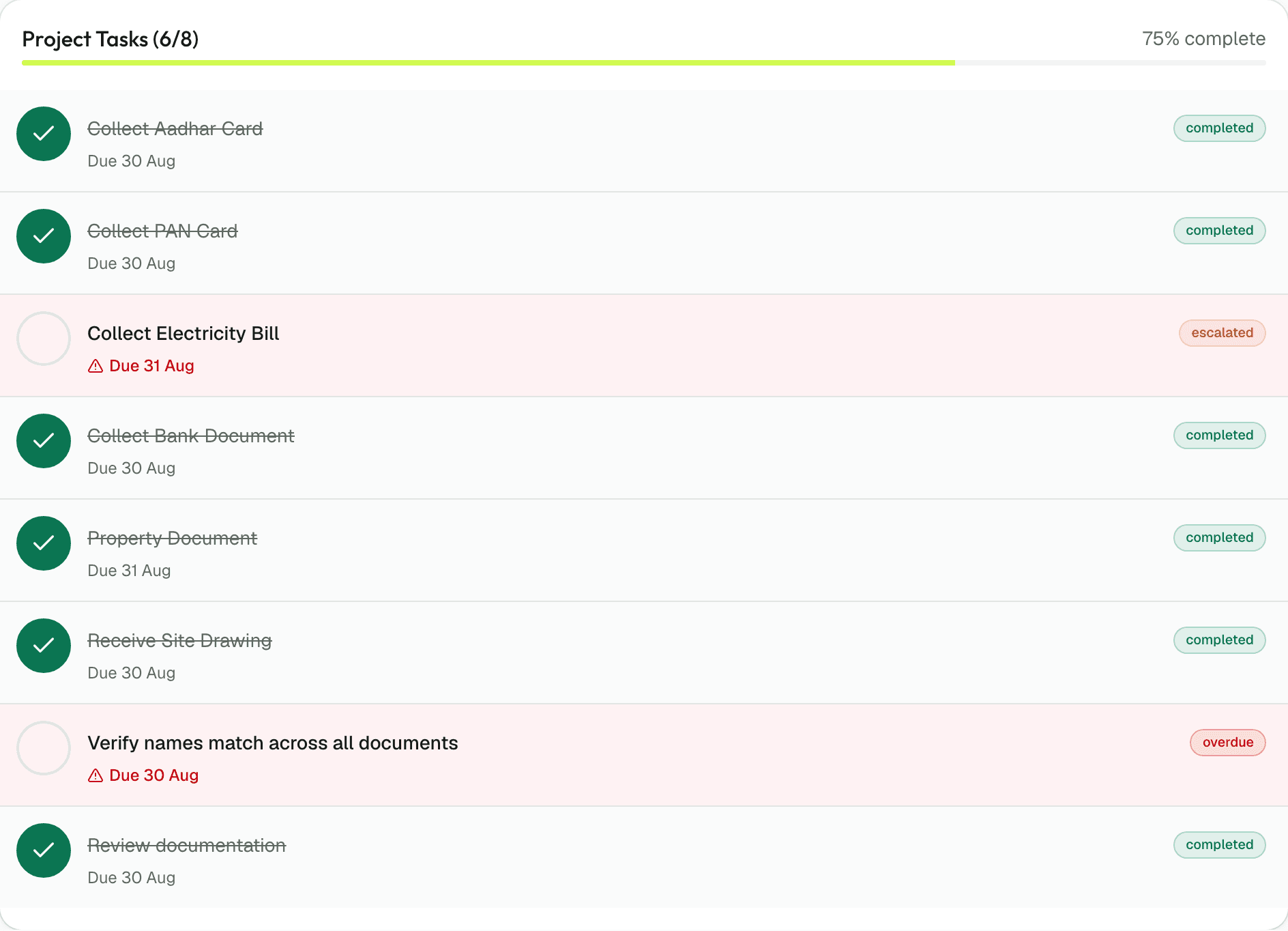
A rooftop job runs sixteen working stages plus completion and cancellation. The moment a project enters a stage, that stage's checklist is written for it — with dates. Nobody types the tasks. Nobody decides when they are due.
Nobody writes the checklist. Nobody gets to skip it either.
- Dates come from the work. Verify Aadhaar, PAN and the electricity bill: one day. Site survey and feasibility: two. Loan sanction: four. Structure installation: ten. Net meter confirmed: fourteen. DCR certificate and PM Surya Ghar: eighteen.
- Only the tasks that apply. Loan tasks appear on loan projects. Subsidy tasks on subsidy projects. Net-meter paperwork matches the electricity board that job actually falls under, whether that is BRPL, PVVNL or DHBVN.
- Your process, not ours. Stages, tasks and the days on them are all yours to edit. Most companies change a handful during setup and then leave it alone.
16 working stages, each with its own checklist — 57 tasks in all, 17 of them conditional on loan, subsidy or the DISCOM.
Miss it, and it stops being your problem
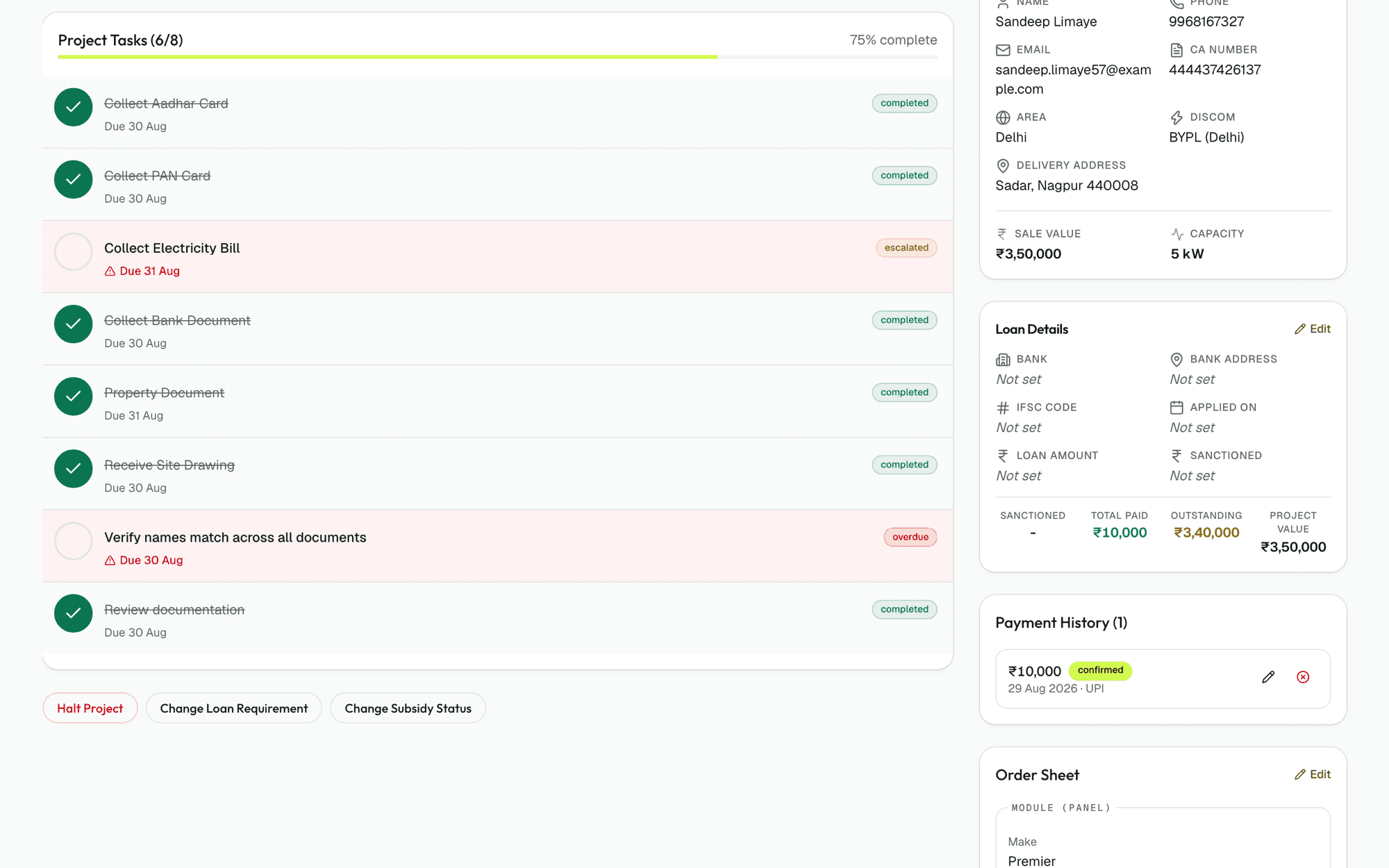
A late task does not sit there going quietly stale. Every night, on its own, it climbs one rung up your org chart — and it keeps climbing until somebody does something about it.
- 1 day lateIt moves to the assignee's manager.Documentation Ops → Ops Head
- 2 days lateTo that manager's manager.Ops Head → General Manager
- 3 days lateOne more rung, the following night.General Manager → Director
- And onUntil it is sitting with someone who can end it at the top of the chart.The top of the chart
It is added, never taken away
The person it started with still sees it on their own list. Escalating is not a transfer and it is not a punishment — it just stops one late job being one person's private problem.
Nobody has to notice
No meeting where this gets raised, no report anyone has to open. It runs every night whether or not the office is thinking about it, and it counts calendar days — so a quiet week catches up on its own.
And the rest arrives anyway
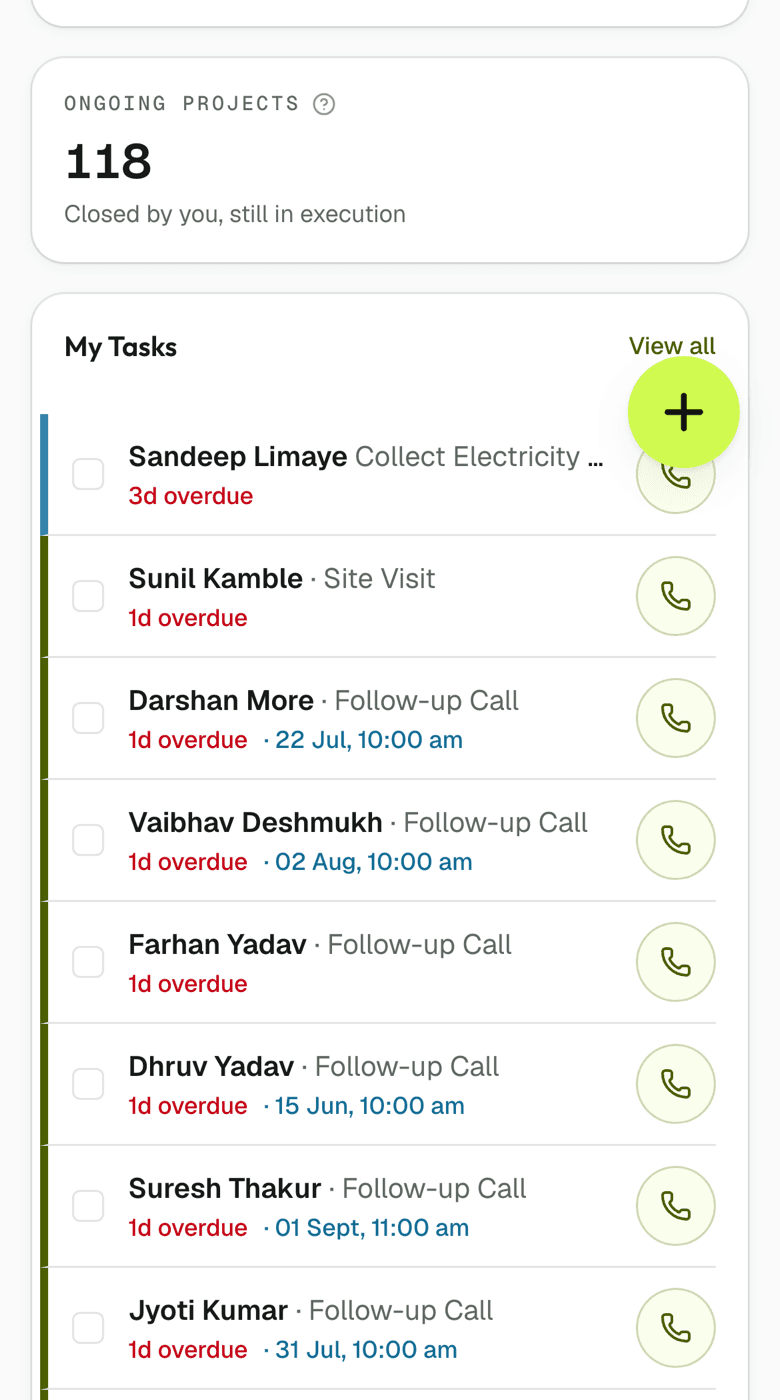
Everyone gets their due-today list by email at 9:00 am IST. Anything overdue on money goes out at 7:00 am IST, to the person responsible and to their manager.
Work stops rotting quietly at the bottom. It rises.
Three steps nobody can skip
A reminder can be ignored on a bad day. These cannot. They are the three places where the software simply will not let the work go forward.
The payment gate
Material does not dispatch until the agreed share of the sale is collected. You set the thresholds — commonly 25 per cent before structure goes out, and 65 per cent for loans or 95 per cent for non-loans before panels and inverter follow.
A reminder asks. A gate decides.
Everyone opens one screen and sees their own work
Ten roles, ten different first screens. Nobody is handed a list in the morning, and nobody has to be asked at night what they got through.
The person doing the work
What is due today, what is late, and where the month stands against their own number. Delivery sees dispatches. QC sees site visits. A telecaller sees a calling list that is already built and already ordered.
The person running them
The same picture for everyone below them, plus who is carrying too much and who is carrying nothing. The standing status meeting stops being the only way to find out.
The person who owns it
Kilowatts against target, cash due, what is stuck and where. One screen that answers the question you currently ask six people to answer.
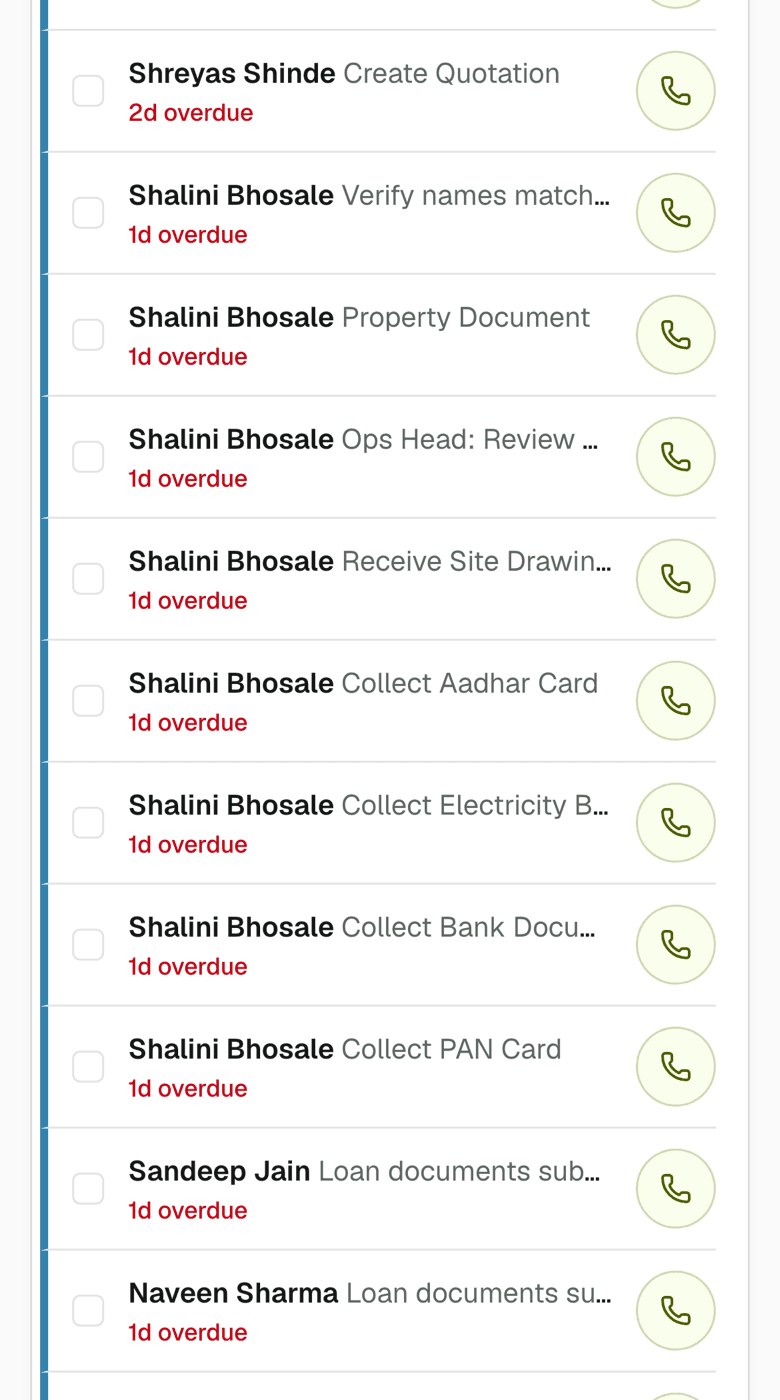
Leads answered in minutes, not days
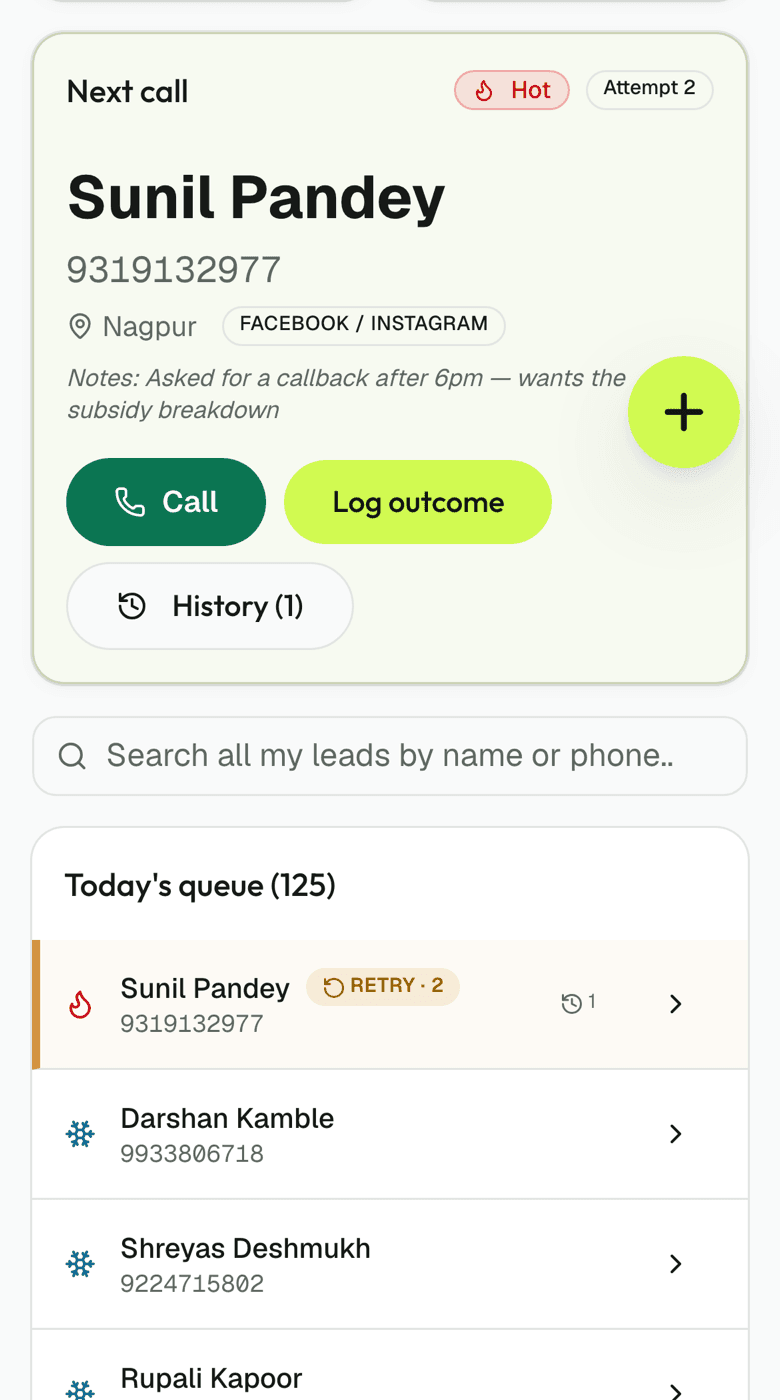
A lead from a Facebook or Instagram ad is on a caller's screen within five minutes of the customer submitting the form — marked hot, at the top of the list, above whatever cold numbers were already there. At one Delhi-NCR EPC, the AI caller booked 322 site visits from 4,922 dials between 27 May and 8 September 2026, from the call log.
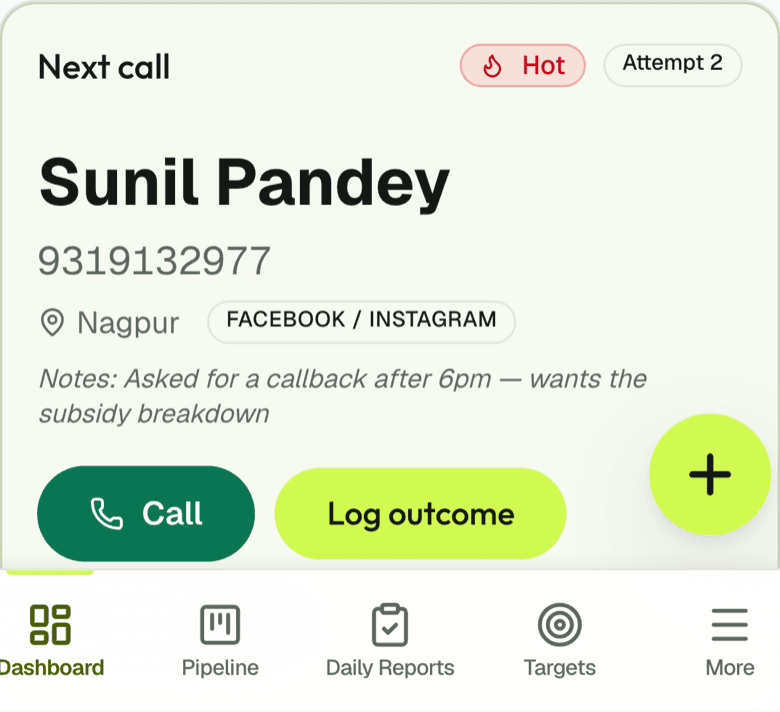
Ask the business a question
Spine is the analyst that sits inside your workspace. You ask in plain words. It answers off your own live data — never a benchmark, never the internet.
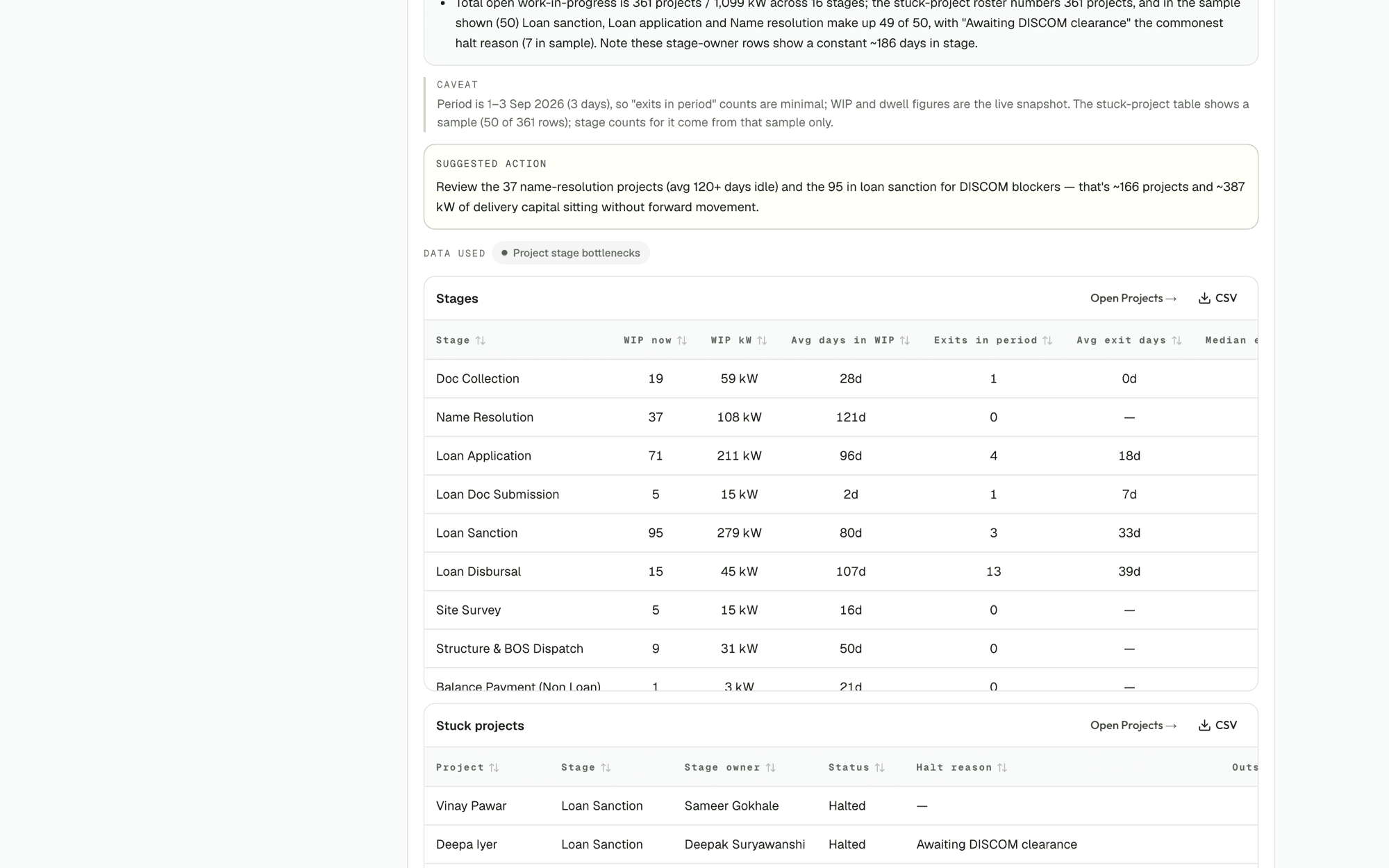
Always the same shape
Finding, evidence, table, caveat, next step. The caveat is not optional — you are told what the answer does not cover before you act on it.
The next step is a human one
A conversation to have, a list to work, a decision to take. It is not allowed to tell you to run another report.
Yours, not everyone's
Spine answers for the director and the general manager. It is deliberately not a screen every role opens each morning.
Money cannot get ahead of the work
Every project carries the schedule you actually agreed — 10/70/20, or whatever you shook hands on — and the whole company can see where it stands.
Illustrative — an ordinary day's instalments, example names, not real customers.
| Project | Instalment | Amount | Status |
|---|---|---|---|
| Sunil Agarwal — 3 kW | On delivery | ₹2,45,000 | Overdue 6 days |
| Kalpana Rao — 8 kW | On delivery | ₹7,10,000 | Due 12 Sept |
| Nandini Deshmukh — 15 kW | Advance | ₹4,90,000 | Cheque bounced |
| Tejas Malhotra — 3 kW | Commissioning | ₹36,000 | Collected |
Money is a task, not a report
An instalment coming due turns up in somebody's list for the day, next to their site visits and their paperwork. Nobody has to remember to open a receivables sheet, because there is not one to forget.
It reaches two people at 7:00 am IST
Anything overdue goes to whoever owns the collection and to their manager, first thing, every day. Not once a week, and not only when you happen to ask.
A bounced cheque reopens
The instalment comes back as outstanding instead of quietly disappearing into a bank statement nobody reconciles until quarter end.
Quotes and GST invoices
Priced quotes and compliant tax invoices with line items come out of the same system that holds the project — so what you invoiced and what you agreed cannot drift apart.
The 70 per cent due on delivery is tracked. Not remembered.
What a Tuesday looks like
- 7:00 am
Before anyone is in
Overdue instalments have already gone to the person responsible and their manager. Anything that went late last night has already climbed a rung. No one opened anything to make that happen.
- 9:00 am
Eleven people, eleven lists
Each person opens one screen and sees exactly their work for the day. Nobody is allocated anything by hand, and the telecallers' queues are already built and ordered.
- All day
A project cannot stall silently
A stuck stage is an open item with a name and a date on it, and if that date passes it goes looking for someone more senior.
- Month end
One list, not six
Every rupee due this month sits in one place, beside kilowatts installed, loans disbursed and net meters activated. The board pack is a screen, not a week of somebody's life.
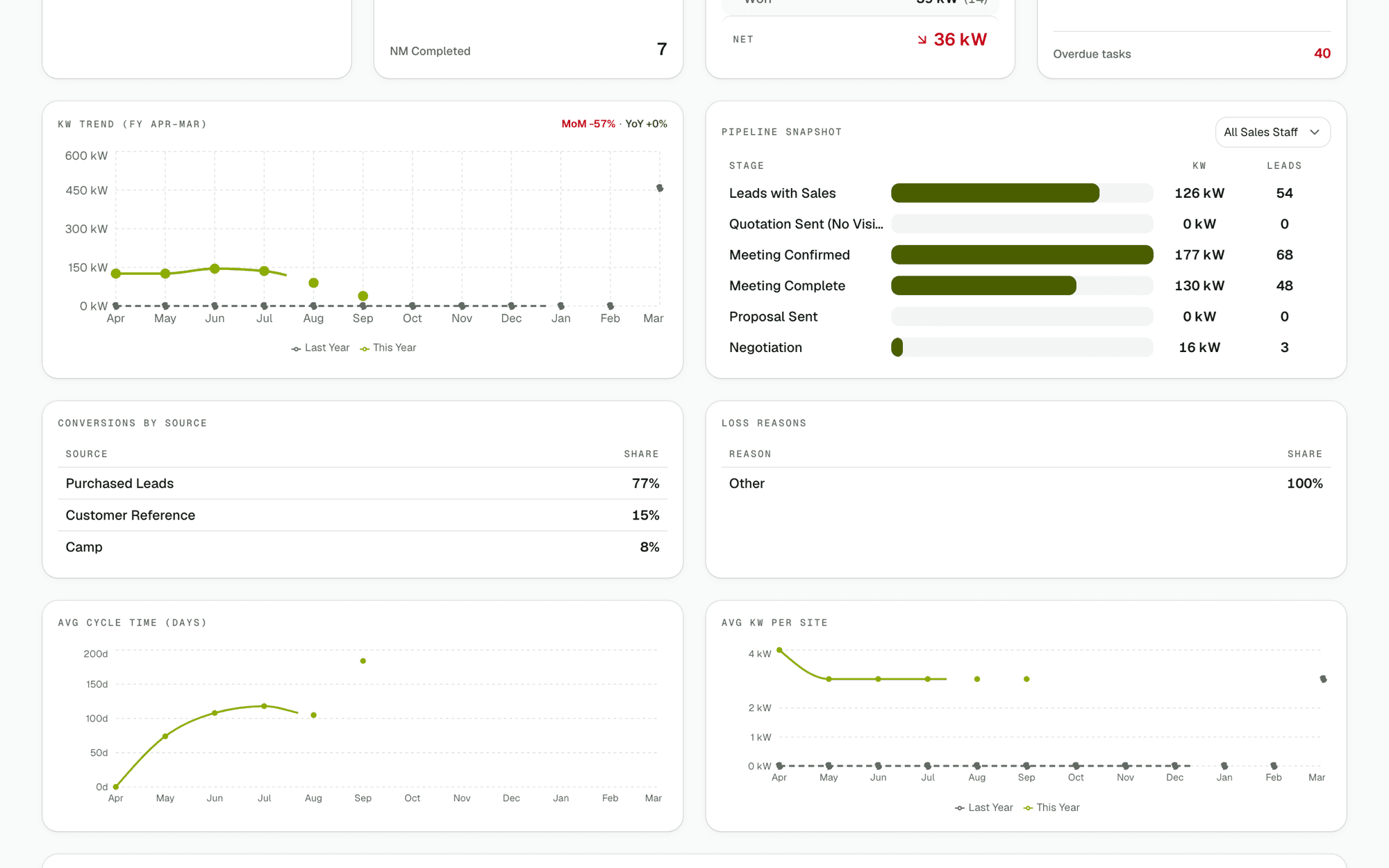
You step in for the exceptions. The week that is left is for growing the business.
Why solar EPCs choose Solar Spine
Eight things that are true on the first Monday you use it — not after a six-month rollout.
One price for the whole company. However many people you put on it.
₹10,000 a month or ₹99,999 a year — 2 months free. Plus 18 per cent GST.
30 days free. No card, no call, no commitment. Set your stages up in the morning and run a real project through it the same week.
Everything else you would ask
What exactly is Solar Spine?
Sales and operations software for solar EPCs. Leads, deals and projects move through 7 sales stages and 18 project stages, each with its own checklist (57 items in all), with payment schedules, dashboards and targets on the same system. One place for the whole business instead of a spreadsheet, a WhatsApp group and a notebook.
Do I have to set up my own stages and checklists?
No. The pipeline ships solar-ready, drawn from a working Delhi-NCR EPC. Moving a project into a stage writes that stage's tasks with due dates, and the checklist is conditional: loan tasks appear on loan projects, subsidy tasks on subsidy projects, and net-meter paperwork matches the DISCOM. Stages, tasks and the days on them are yours to edit.
How does pricing work?
One plan, one price for the whole workspace: ₹10,000 a month, or ₹99,999 a year, plus 18% GST. Users are unlimited, so hiring five more people does not change the bill. Every feature is included. Start with a 30-day free trial with no card.
How do I pay?
From inside the product, through Razorpay, by UPI, card or netbanking. Monthly renews automatically on a UPI Autopay or card mandate and you can stop it any time from Billing. Yearly is a single payment that never renews on its own. A GST tax invoice is issued for every payment. If a payment is late we email you every day from two days before until five days after, and access stays open the whole time. Six days past the date the workspace turns read-only, which reverses the moment you pay. Nothing is deleted.
Does it handle loan and subsidy projects?
Yes. Deals and projects carry capacity in kW, loan, subsidy and DISCOM out of the box, and stage checklists branch on them: loan-only tasks appear only on loan projects, PM Surya Ghar and GBI steps only where subsidy applies.
How does it handle payments and collections?
Every project carries the schedule you agreed, such as 10/70/20 against booking, delivery and commissioning, with due dates, amounts received and the outstanding balance visible to everyone. Material does not dispatch until the agreed share is collected. Overdue instalments reach the owner and the manager at 7 am. A bounced cheque reopens the instalment. GST invoices come out of the same record.
Can I import from spreadsheets or another CRM?
Yes. Bulk-upload calling lists from Excel or CSV with a downloadable template. Anything you can export from Zoho or a Google Sheet comes straight in and lands in the calling queue. Meta lead ads flow in automatically. Everything exports back to Excel in one click, any time.
Is my data safe?
Every workspace is isolated from every other at the database level, in a Postgres database in Mumbai. Customer documents sit in a private store and identity papers are visible only to the people on that project. You can export everything in one click whenever you want it. No lock-in.
Who is Millennial AI?
A B2B product studio in Mumbai. Solar Spine grew out of the system we built and ran for a Delhi-NCR solar EPC, productised so any solar company can run on it.
Run one real project through it this month. You will know by the end of it.
30 days free, no card, no call. Then ₹10,000 a month for the whole company, however many people you put on it.