You ring people for status instead of asking the data
What goes wrong
You need to know which lead source actually paid for itself last quarter. A benchmark tells you what other companies do. It does not tell you whether Facebook or camps worked for your site. You ring Sneha (the GM), she checks a spreadsheet someone updated last week, and by the time you have an answer the week is over. The data sits in your own system but nobody can ask it a question.
Your cash is stuck at net meter and your projects are taking forty-seven days instead of twenty-eight to reach collection. You cannot see whether it is a documentation bottleneck, a DISCOM delay, a loan sanction wait, or customers simply not paying on time. You do not have a place to ask. You write an email. Someone responds three days later with a number that does not match what you remember seeing.
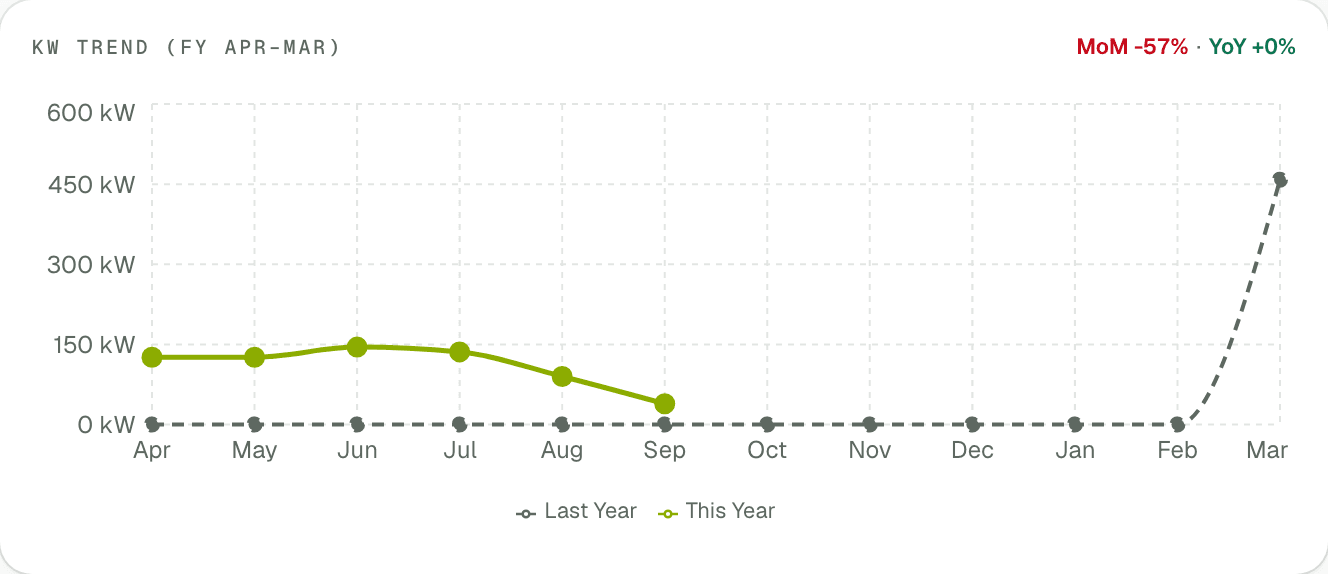
Installation rates dropped this month. You have no idea if sales dried up or delivery is just slower. A manager knows the answer in their head but you do not have a system that lets you ask it. You lose a week guessing, and that week costs kW.
How it works
You ask for solar business analytics in plain English
Which lead source returns more than it costs? Are we moving faster or slower on net meter? Why did collection jump in August? Who is carrying too much work? You type the question into the Spine interface. Behind the screen, the system maps it to the data it needs and calls the queries that assemble the answer.
Spine retrieves your actual data
Instead of running a fixed report, the system calls multiple data queries (cuts) to assemble the pieces it needs to answer you. It pulls won deals with their values and kW, payment records from your ledgers, projects by stage with their timelines, lead sources and the spend against each one. Every piece of data is yours — the deals you have won, the collections you have received, the projects you own.
The answer is labelled, not a wall of text
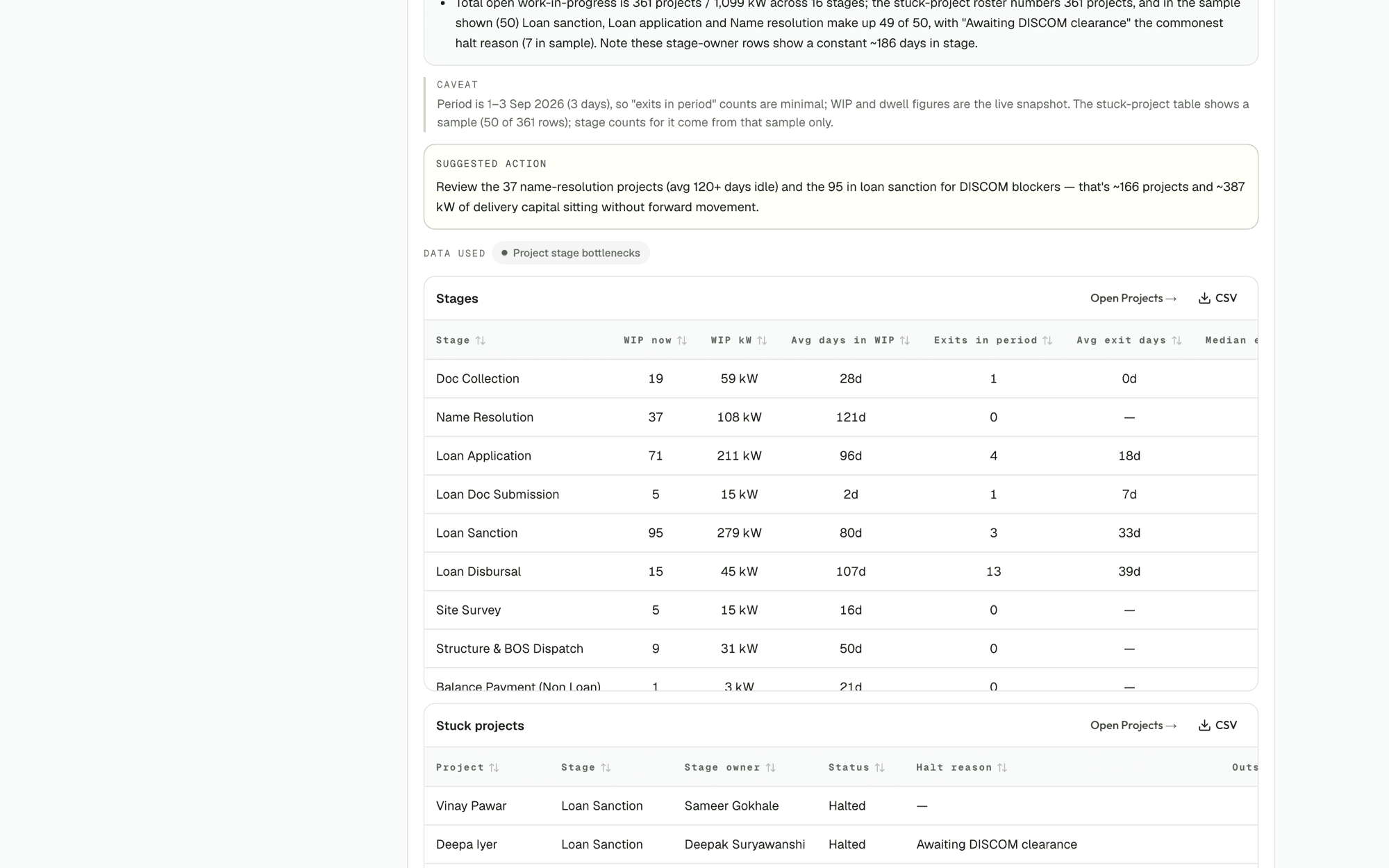
Every answer opens with a Headline, one sentence carrying the number, and Evidence: two to six bullets, each citing the table it came from. A Table follows when the question compares people, sources or stages, not for a single figure or a yes-or-no. A Caveat appears only when the data has a real limit worth stating: a sample instead of the full set, a lag, a note on the numbers. It is left out when there is none. A Next step names something a person does next, and is skipped when the data does not point to one.
Only directors and GMs see it
Ask-AI is not a screen every role opens each morning. It answers for directors and general managers who own the decisions. A telecaller does not need business analytics; they need their calling list. A delivery lead needs their checklist and tasks. A director needs to know whether to press harder on collections or hiring, and that choice comes off your live data, not a hunch or a report someone spent a week building.
You stay on the fast path
Ask a fast question when you want the number now: Spine pulls the data and answers straight away. Ask a deep question when the answer needs reasoning across several cuts of the data, and it takes longer and goes further. Every director and general manager has their own daily allowance, so one person's heavy day does not cost anyone else theirs. The allowance resets at midnight IST. It is there to keep the analyst a tool for decisions rather than a toy, and in practice a working day rarely comes near it.
Everything else you would ask
What is the difference between fast and deep reasoning?
A fast question asks Spine to pull data and answer immediately. A deep question asks it to reason through the data, call back for more detail if needed, and write a more thorough analysis. Most questions a director asks in a day are fast ones; deep questions suit a month-end review or a decision you want argued out.
What if the answer is wrong?
Answers draw from your own live data, not from a training set or the internet. If a figure is wrong, the data in your system is wrong. Where the data has a real limit (a sample instead of the full set, a lag, a gap), the answer carries a caveat saying so. When there is none to state, the caveat is left out rather than padded. Every answer has a thumbs up and a thumbs down next to it, so you can mark one you do not trust.
Can my team members see my questions and answers?
No. Every question stays private to the person who asked it. Each director or GM sees only their own threads and their own answers. The system does not make any answers visible to sales staff, delivery ops or anyone else.
Is there a limit on questions?
Yes, a daily allowance per director and general manager, which resets at midnight IST. It is generous for a working day and it is flat: everyone in your leadership has the same access, and nothing is metered by the workspace as a whole. If you hit it, Spine tells you and the next morning it is back.
Can I export the tables?
Yes. Every answer table sits on your screen and a download button hands you the CSV. You can drop it into a spreadsheet and filter however you like. The tables show exactly what Spine saw when it answered your question.
What does Spine not do?
It does not predict the future. It does not benchmark you against competitors. It does not chase your customers. It does not run a fixed report every morning. It answers the question you ask, not the question you forgot to ask. For complex multi-month analysis, you might need to ask a follow-up to let Spine dig deeper.
Run one real project through it this month. You will know by the end of it.
30 days free, no card, no call. Then ₹10,000 a month for the whole company, however many people you put on it.