Solar leads from Meta reach your team the same day, not three days later
What goes wrong
Your sales head sees the ad lead on Friday evening. The telecaller reaches it Tuesday morning. The customer signed with a competitor on Monday. The business is not in your people's discipline—it is in your lead age, and a three-day gap kills deals you never knew existed.
Meta's algorithm learns from what it can measure: form submissions. It does not know if the lead converted to a solar installation or just got good at filling in forms. You are paying for one thing and Meta is optimising towards the other, so cost per qualified lead drifts upward while the lead quality stays flat.
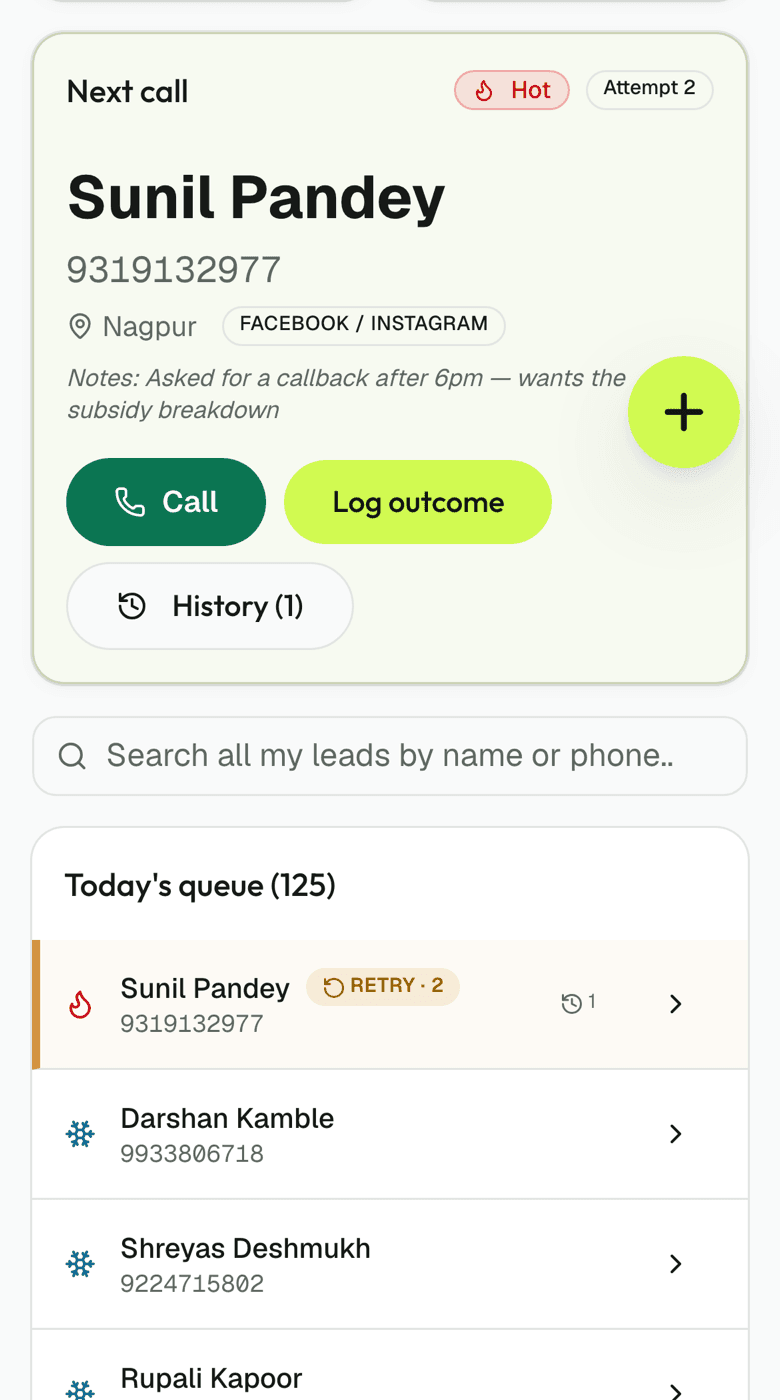
Your calling queue is built by hand, or by a simple rule like oldest first. A hot Meta ad lead lands in the same queue as three-month-old purchased phone numbers. Nothing stops your team calling the cold list first because nobody told them this one just arrived and is worth more.
Each time your workspace adds a service area or a DISCOM, someone manually updates a spreadsheet, and someone else checks it before handing a lead to the AI. One manual sync misses and you are calling areas you do not service, wasting money and confusing customers.
How it works
Customer fills your Meta form
On Facebook or Instagram, a customer submits your lead ad form with their name, phone number and location. Meta records the submission and waits for your Apps Script to fetch it.
Sheet posts the new lead to your system
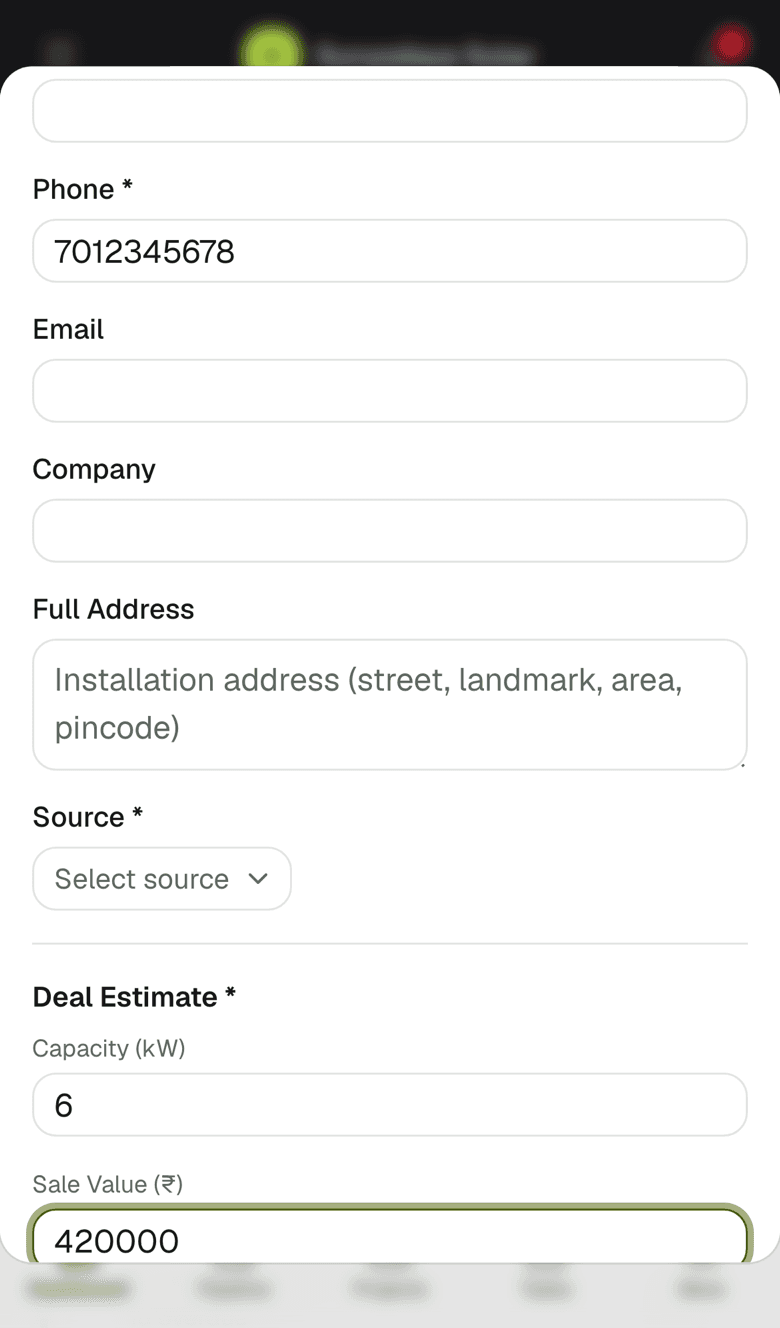
An Apps Script on your Google Sheet wakes every few minutes and sends any new rows to your workspace via an API key that identifies your organisation. One bad phone number or malformed row does not block the ones behind it—each row commits independently so a minor error never wedges your entire lead stream.
System checks the PIN against your service area
The system normalises the customer's PIN code to a clean six-digit number and checks it against the serviceable PINcodes you have configured for your workspace. If you do not yet have PIN codes configured, leads route to your AI caller or to your team as usual—the gate never closes, it just opens wider or narrower.
Solar lead enters the calling queue as hot
The new lead lands on your telecaller's screen at the top of their queue, marked hot and showing the campaign, platform and the time it arrived. The source sits on the card so your caller knows this one came from an ad you paid for, not from a purchased list or a doorstep survey.
Outcome goes back to Meta
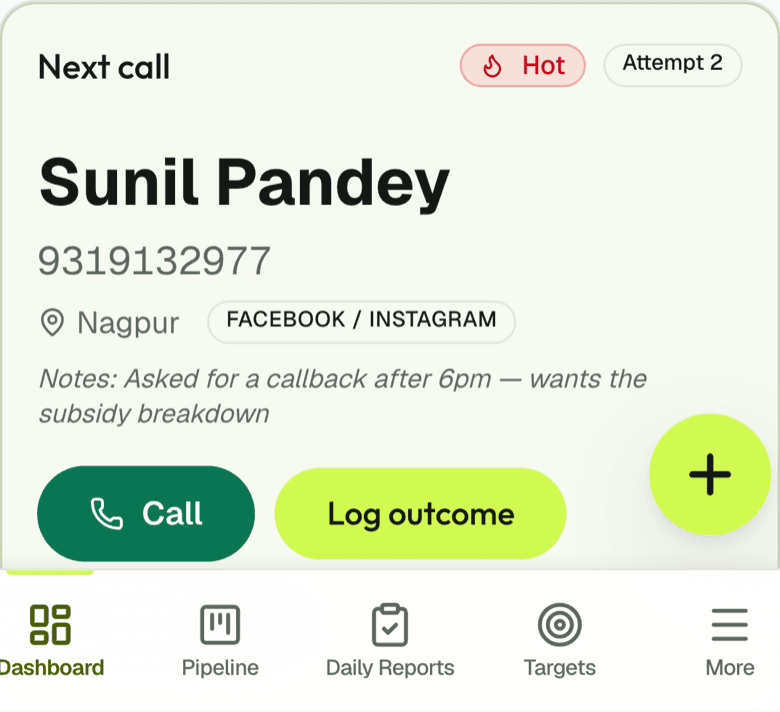
When your caller logs the result (qualified, converted or disqualified), that outcome is written to Meta's Conversions API so their algorithm learns which lead sources actually convert. Meta then re-optimises your ad spend towards people likely to buy a solar system rather than people who only fill in forms.
Everything else you would ask
What makes a lead 'hot'?
A hot lead is one that just arrived and is still fresh enough to convert. On your telecaller's screen, hot leads sit at the top of the queue, above older numbers from purchased or cold lists. The system marks every new Meta form submission as hot the moment it enters your workspace, ahead of the caller's existing list, and the AI caller always tries the freshest lead first.
Will it work if I also run ads on Google or LinkedIn?
No. This integration reads from a Google Sheet that Meta's native Sheets connector populates. Google ads and LinkedIn ads do not feed into Meta's Sheets integration, so those leads would need a separate flow. You would set up a different source in your lead sheet for them—perhaps a manual row, or a Zapier integration if Google or LinkedIn support it.
What happens if the customer's PIN code is outside our service area?
The system checks the PIN against your configured serviceable PINcodes for your workspace. If the PIN is not serviceable, the lead still appears in your calling queue—the gate never blocks the lead, it just flags it with a remark so your caller knows to ask qualifying questions about location. You can always add new PINcodes to your service area mid-month, and new leads respect the updated list immediately.
Can the AI caller handle a Meta lead?
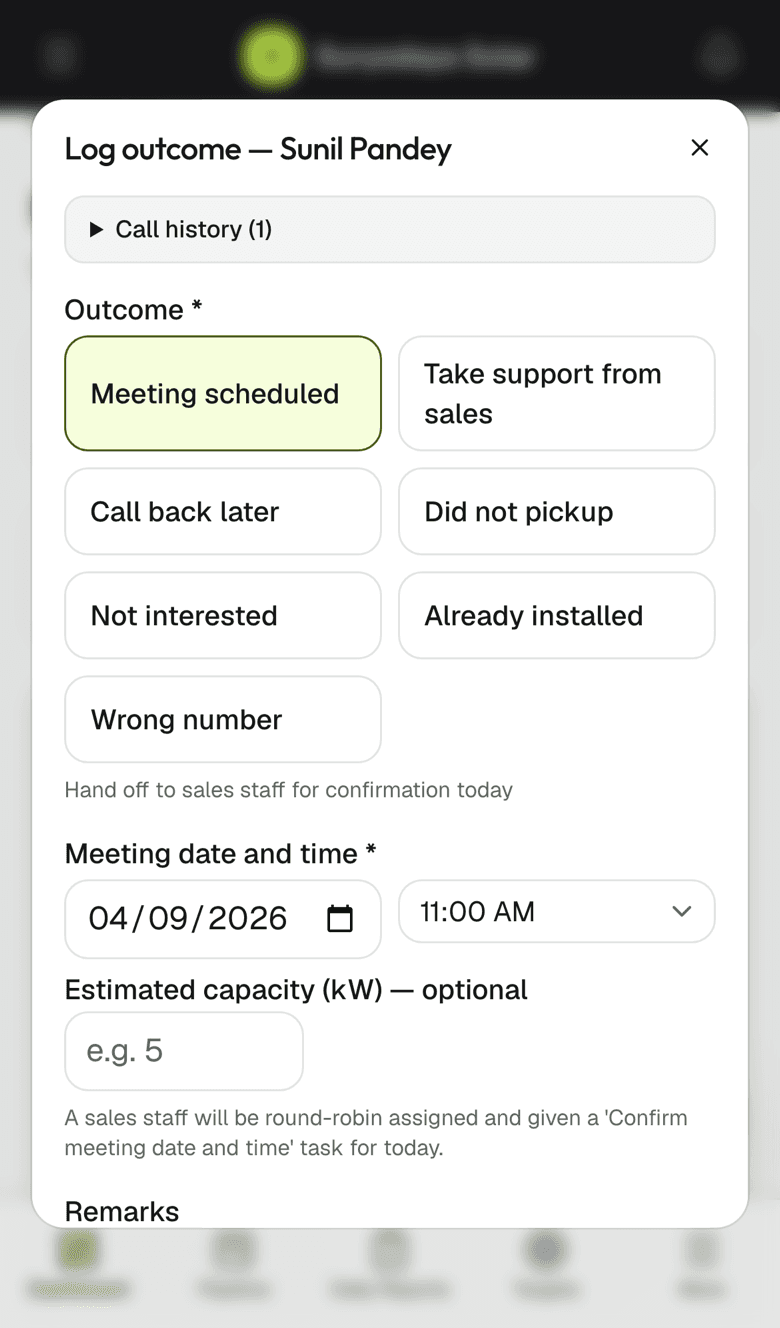
Yes. If you have the AI caller turned on, Meta leads that fall within your serviceable PINcodes route to the AI caller first. The AI dials between 9 am and 9 pm IST, qualifies the customer, books a site visit on a named salesperson's day, and creates the deal and the follow-up task. An unanswered call is retried automatically up to a set number of attempts; if the AI decides mid-call that a person should take over, it transfers the lead to a human telecaller with its own notes attached.
Does Solar Spine optimise which Meta ads to spend on?
No. Solar Spine does not control your ad spend or ad creative. It reads the lead outcomes (qualified, converted, disqualified) and writes them back to Meta's Conversions API so Meta's algorithm can learn which audiences and placements actually convert. You stay in control of creative, budget allocation and ad targeting; Meta uses the conversion data to refine the audience.
What if someone submits the form with a fake phone number or no location?
A lead with a missing or invalid phone number is skipped and reported in the batch result so your Apps Script knows to flag it. A lead with no valid PIN code is marked with a 'no PIN' remark and still appears in your queue—your caller is the final gatekeeper and can decide whether to try it. Malformed rows do not stop the batch; one bad lead never wedges the entire sheet.
Run one real project through it this month. You will know by the end of it.
30 days free, no card, no call. Then ₹10,000 a month for the whole company, however many people you put on it.