How the net metering process works in Delhi, UP and Haryana
By Nabeel Tauheed · 9 September 2026 · 6 min read · Compliance
In short
- DERC requires Delhi's distribution licensees to complete technical feasibility within fifteen days of a complete application for systems above 10 kW, under the First Amendment Regulations notified 26 July 2024; systems up to 10 kW are exempt from a feasibility study.
- Delhi's 2014 guidelines set a deadline for every later stage too: seven days to invite registration, forty-five days to scrutinise it, thirty for the connection agreement and fifteen to fit the meter, a 112-day regulatory ceiling if nothing is deficient, not a typical wait.
- Uttar Pradesh's UPERC regulation gives the DISCOM thirty days for feasibility, ten for approval, fifteen for registration and thirty for the interconnection agreement, an 85-day ceiling before meter installation, on which UPERC does not set a fixed deadline.
- Haryana's HERC amended its rules on 15 July 2024 to require a feasibility finding within fifteen days, deeming the system feasible if the DISCOM stays silent, and exempted systems up to 10 kW entirely; HERC has not published a matching deadline for the agreement or meter-installation stages.
- None of the three regulators publishes how long a division typically takes once an application is complete, only the deadline before a delay can be formally raised, so the only reliable number is the one an EPC logs itself.
The net metering process in Delhi, Uttar Pradesh and Haryana runs on deadlines the regulator sets, not ones an EPC can negotiate. DERC gives Delhi's three distribution licensees fifteen days to complete a technical feasibility check on any system above 10 kW; UPERC gives Uttar Pradesh's DISCOMs thirty days for the same step; HERC's amended rule for Haryana is also fifteen days. In all three states, nothing below 10 kW needs a feasibility study at all. Feasibility is only the first of several statutory stages, and each one carries its own clock. None of the three regulators publishes how long a division typically takes once the paperwork is complete, only the outside limit before a delay becomes something you can formally raise.
The net metering process in Delhi under DERC rules
Technical feasibility in Delhi is governed by the DERC (Net Metering for Renewable Energy) Regulations, 2014, as amended on 26 July 2024. The amendment exempts systems up to 10 kW from a feasibility study altogether, with the distribution licensee handling any load or transformer upgrade itself, and requires feasibility for anything larger to be completed within fifteen days of a complete application.
Feasibility is only the first of six stages set out in DERC's 2014 guidelines, and each one has its own deadline: seven days for the licensee to invite a feasibility-cleared applicant to register, forty-five days for the licensee to scrutinise that registration once filed, thirty days to execute the connection agreement after registration, and fifteen days to install the net meter once the system itself is up. Add the licensee's own clocks together, fifteen, seven, forty-five, thirty and fifteen, and the regulation allows itself up to 112 days from a clean application to a working meter. That is a ceiling, not a typical wait: it assumes no deficiency, no resubmission, and an applicant who moves the moment each intimation lands. BRPL, BYPL and TPDDL all answer to the same clock; DERC does not publish how each one performs against it.
The five-stage process in Uttar Pradesh
Uttar Pradesh's DISCOMs, including PVVNL (Pashchimanchal Vidyut Vitran Nigam, serving Meerut and the western districts) and NPCL (Noida Power Company, serving Noida and Greater Noida), work under the UPERC (Rooftop Solar PV Grid Interactive System Gross/Net Metering) Regulations, 2019. The regulation sets out five stages: feasibility analysis, approval, registration, the interconnection agreement, and meter installation.
Feasibility analysis is due within thirty days of a complete application. Where a deficiency needs curing, the applicant gets thirty days to fix it before the application lapses and the fee is forfeited; once documents are in order, the DISCOM has ten days to confirm approval. Registration follows: the DISCOM has fifteen days to register a complete form, or to flag what is missing. The interconnection agreement is due within thirty days of the registration number being issued, and the applicant has a further thirty days to sign and return it. Add the DISCOM's own clocks with no deficiency cycle (thirty for feasibility, ten for approval, fifteen for registration, thirty for the agreement) and the regulation allows itself an 85-day ceiling before the physical meter stage even starts. UPERC's regulation does not set a fixed number of days for meter procurement and installation itself, which is where most of the schedule risk sits in practice.
What Haryana's amended rules say
Haryana's two DISCOMs, DHBVN (Gurugram and Faridabad) and UHBVN (the rest of the state), operate under the HERC (Rooftop Solar Grid Interactive Systems Based on Net Metering/Gross Metering) Regulations, 2021. HERC amended these rules on 15 July 2024: a technical feasibility finding is now due within fifteen days, and if the DISCOM says nothing in that window the system is deemed feasible. Systems up to 10 kW are exempt from the feasibility study entirely, the same threshold Delhi uses.
HERC has not published an equivalent fixed deadline for the connection agreement or meter installation stages that follow feasibility, at least not in the amendment coverage available at the time of writing. Where a regulator has not set a number, this piece does not invent one. Ask your DISCOM's divisional office directly what it commits to for those stages, and track the date they give you.
Tracking the process instead of guessing at it
Every stage above has a real deadline attached to it in the regulation, but the regulation only tells you when you are allowed to escalate, not how long the DISCOM usually takes. The practical answer comes from your own log: the date you submitted, the date the clock is supposed to expire, and whether anyone followed up when it did.
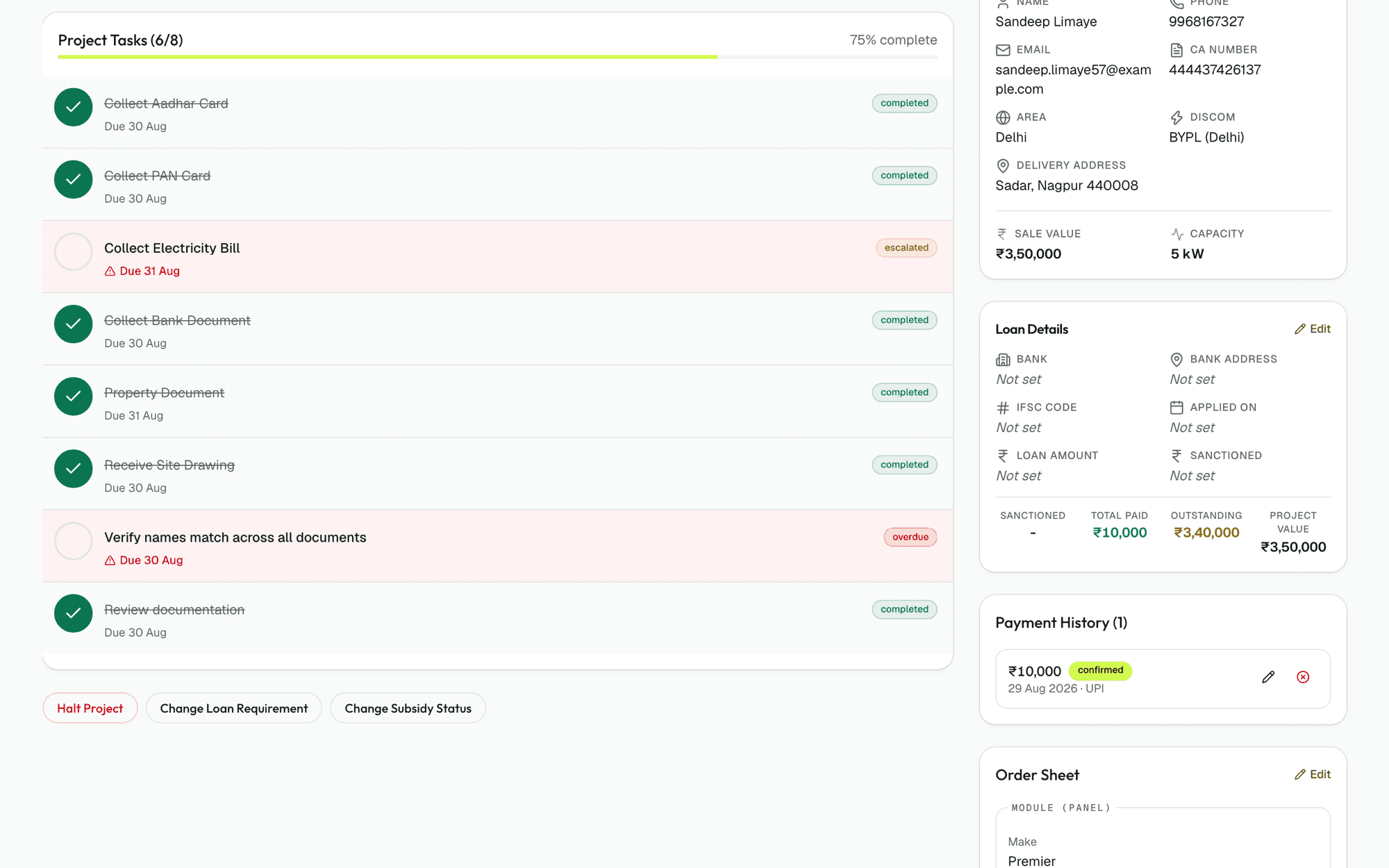
Solar Spine tracks net metering the way it tracks a loan sanction or a subsidy claim: as a stage task with a due date set the day the stage opens, so feasibility, registration and meter installation each carry their own deadline instead of one vague status. An overdue net-meter task climbs one rung of the org chart every night it stays open, the same way a late instalment does, and the stage cannot advance while the task sits open. It will not make BRPL, PVVNL or DHBVN move faster. It only makes sure nobody on your team forgets the date the regulation gave you.
A statutory clock only helps once you know when it started ticking.
Sources
- Delhi Electricity Regulatory Commission (Net Metering for Renewable Energy) (First Amendment) Regulations, 2024
- Guidelines under DERC (Net Metering for Renewable Energy) Regulations, 2014
- UPERC (Rooftop Solar PV Grid Interactive System Gross/Net Metering) Regulations, 2019
- Mercom India, Haryana issues draft amendment to rooftop solar rules
- SolarQuarter, Haryana simplifies rooftop solar rules with key amendments
Related
Run one real project through it this month. You will know by the end of it.
30 days free, no card, no call. Then ₹10,000 a month for the whole company, however many people you put on it.