The GBI solar subsidy pays out monthly, and only in Delhi
By Nabeel Tauheed · 8 September 2026 · 6 min read · Compliance
In short
- Delhi's Generation Based Incentive pays ₹3 a unit for rooftop systems up to 3 kW and ₹2 a unit for 3-10 kW, credited monthly for five years from commissioning (Delhi Solar Energy Policy 2023, EEREM and the Delhi Solar Portal, read 9 September 2026).
- GBI stacks on top of, not instead of, the central government's PM Surya Ghar subsidy of up to ₹78,000 for a 3 kW system (Cabinet approval, 29 February 2024) and Delhi's own capital top-up of ₹10,000 a kW capped at ₹30,000.
- Uttar Pradesh has no per-unit GBI: UPNEDA pays a one-time top-up of ₹15,000 a kW capped at ₹30,000, not a generation incentive (Mercom India).
- Haryana's 2021 net-metering regulation lets DHBVN and UHBVN pay a generation incentive, but the rate is set each year in a tariff order the commission has not published a figure for as of this writing (HERC Regulations, 2021; Energetica India, 6 January 2025).
- GBI cannot start until net metering is live: at one Delhi-NCR EPC, that DISCOM-side stage is consistently one of the slower ones in the pipeline, from that EPC's own project data, not a published DISCOM average.
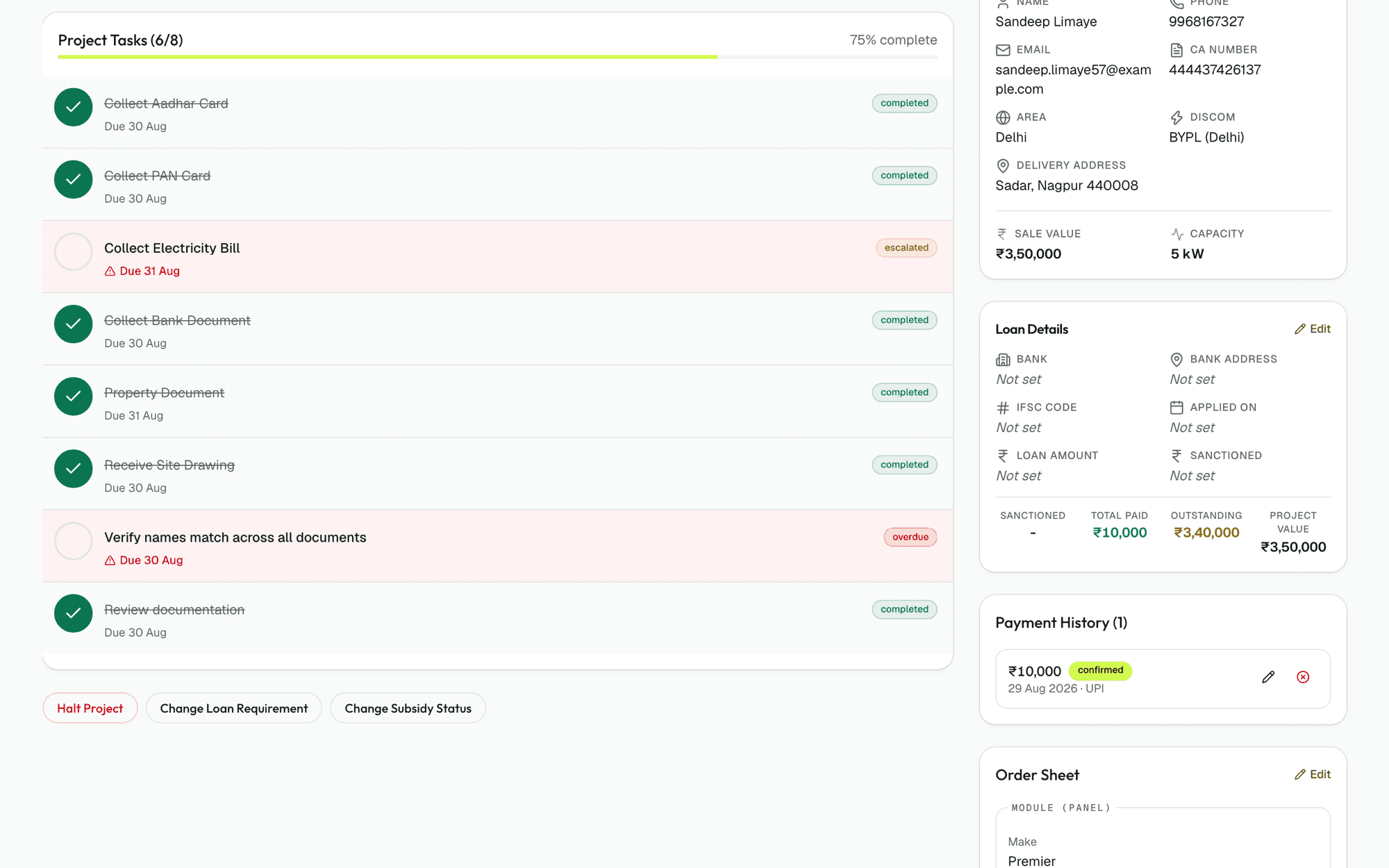
The GBI solar subsidy is Delhi's Generation Based Incentive, and it is a Delhi scheme, not a national one. It pays ₹3 for every unit a rooftop system up to 3 kW generates, and ₹2 a unit for 3 to 10 kW, credited against the customer's electricity bill every month for five years from the date the system is commissioned. It runs alongside the central government's PM Surya Ghar subsidy, not instead of it. Uttar Pradesh and Haryana, the two other states BRPL, PVVNL and DHBVN customers of a Delhi-NCR EPC will also serve, do not currently pay an equivalent per-unit incentive — quote one to a UP or Haryana customer and you are quoting money that is not coming.
What the GBI solar subsidy pays in Delhi
Delhi's Solar Energy Policy 2023 sets four rates. A residential system up to 3 kW earns ₹3 a unit; one from 3 to 10 kW earns ₹2. A group housing society or RWA installation up to 500 kW earns ₹2 a unit. Commercial and industrial consumers earn ₹1 a unit, but only on the first 200 MW of C&I capacity the policy accepts, an early-bird cap, not a rate that holds forever. All four run for five years from commissioning. The DISCOM, BRPL, BYPL or TPDDL depending on the site, adjusts the amount against the customer's monthly bill and pays any balance to their bank account — GBI shows up as a recurring credit, not a one-time cheque.
This is separate from Delhi's own capital subsidy, which tops up the central scheme by ₹10,000 a kW capped at ₹30,000 for a residential system. A Delhi customer is looking at three different payments with three different mechanics: a one-time central subsidy, a one-time state top-up, and a monthly GBI credit that keeps arriving for five years. Conflating any two of them in a customer conversation is where trust gets lost.
GBI is on top of the central subsidy, not instead of it
The Cabinet approved PM Surya Ghar's central subsidy in February 2024. It pays ₹30,000 for a 1 kW system, ₹60,000 for 2 kW, capped at ₹78,000 for 3 kW or larger, once, by direct transfer to the customer's Aadhaar-linked account, after the DISCOM confirms commissioning. That is a capital subsidy against the system's cost. GBI is a different instrument entirely — a payment against what the system actually generates, arriving in instalments over five years rather than as one transfer. A customer who qualifies for both is not choosing between them: the central subsidy reduces what they pay upfront, and GBI reduces what they pay every month afterwards. How the central subsidy itself gets claimed, the registration, the ALMM panel requirement, the timing against commissioning, is its own process, and it has to close before GBI can start.
Uttar Pradesh and Haryana don't have Delhi's GBI
Uttar Pradesh, where PVVNL and NPCL are the DISCOMs, has no per-unit generation incentive at all. UPNEDA's state support is a one-time top-up of ₹15,000 a kW, capped at ₹30,000 per consumer, paid on top of the same central subsidy — capital money, not generation money, and nothing recurring after commissioning.
Haryana sits in between. HERC's 2021 rooftop solar regulation does let DHBVN and UHBVN pay a generation incentive "as may be approved by the Commission in the ARR/Tariff Order for the relevant year" — the framework exists, but the rate is not fixed in the regulation itself, and it has to be set fresh each year. Coverage of Delhi and Haryana's incentives as recent as January 2025 lays out Delhi's ₹3-and-₹2 rates in full and does not show a Haryana figure to put next to them. Until a commission order actually sets one, do not promise a Haryana customer Delhi's numbers, or any number.
Net metering has to be live before any unit is billed
GBI pays on metered generation, which means nothing accrues until the net meter is live and the DISCOM has signed off on commissioning. That approval is DISCOM-side and runs on the regulator's own clock, not the EPC's: the deadlines differ by state and by stage, and none of the three regulators publishes how long a division typically takes once an application is complete, only the outside limit before a delay becomes something you can formally raise. At one Delhi-NCR EPC, the project stage that covers this, net-meter activation, is consistently one of the slower stages in the pipeline — DISCOM-side and outside the EPC's own control, and one company's operating experience, not a regulatory benchmark. It is the closest real signal for "how long before GBI starts" that either the regulations or the industry publish, even without a fixed figure attached to it.
How Solar Spine tracks the net-meter gate a GBI payment waits on
Solar Spine cannot make a DISCOM commission a meter faster, and it does not touch GBI's rate or its rules: those are the state's to set. What it does is write a net-meter activation task the day a project enters that stage, with a due date already on it, and it will not let the stage advance while that task sits open. An overdue task climbs one rung of the org chart every night until someone closes it, and it shows up in the same due-today email as every other open item on the project. That consistently-slow pattern is what this visibility looks like on one Delhi-NCR EPC's own projects — not a guarantee any project will match it, but a record of how long the gate actually took, project by project, instead of a number nobody wrote down.
Get the net meter live, and GBI starts accruing on its own schedule. Nothing about tracking the stage changes what the DISCOM or the state pays — it only stops the wait from going unnoticed.
Sources
- Delhi Solar Energy Policy 2023, EEREM
- Delhi Solar Portal, State Subsidy
- Cabinet approves PM-Surya Ghar Muft Bijli Yojana for rooftop solar in one crore households
- UP Announces ₹15,000-30,000 subsidy for residential rooftop solar systems up to 10 kW, Mercom India
- HERC (Rooftop Solar Grid Interactive Systems Based on Net Metering/Gross Metering) Regulations, 2021
- Understanding solar incentives in Delhi and Haryana, Energetica India
Related
Run one real project through it this month. You will know by the end of it.
30 days free, no card, no call. Then ₹10,000 a month for the whole company, however many people you put on it.