Why solar site visits fall through, and what a solar site survey app fixes
By Nabeel Tauheed · 8 September 2026 · 8 min read · Sales
In short
- A solar lead from a paid ad loses value hourly if the site visit stays unbooked for two days.
- Qualification takes too long when it is done by a person writing things down, leaving leads in limbo while better prospects move forward.
- Booking the site visit inside the same call as qualification can multiply the site-visit rate four to six times and needs fewer people to run the calling queue.
- A solar site survey app that books the visit inside the initial call and sends it straight to a named salesperson recovers deals that vanish into manual queues.
Site visits fall through because your leads age between the phone call and the booking, and the faster your competitor books them the fewer you see. The gap is not days; it is hours. A prospect who fills your Meta ad form at an illustrative 3 pm on Friday is somebody's customer by Tuesday morning if you do not call them the same day. Even once they answer the phone, if qualification takes an illustrative three days and scheduling takes another three, the site visit lands a week later, by which point half your leads have signed with someone else, moved to a cheaper option, or stopped returning calls. A solar site survey app that books the visit inside that first call, instead of leaving it for a second one, is the fix most EPCs have not tried.
The problem is not your people. It is the shapes you ask them to work in. A telecaller qualifying a lead by hand, writing notes, passing the qualified prospect to a scheduler who types it into a calendar, who then texts the customer to pick a date—that is a Xerox-era process in an app. A solar site survey app built into the calling flow changes this: the prospect agrees on a date before the call ends, their answers land on the salesperson's screen before the day is done, and nobody calls them twice. Every handoff removed is where leads stop getting lost, and every step taken out of the booking process brings the site visit one day closer.
Why site visits stop happening
A lead goes cold in an illustrative forty-eight hours if nothing moves. When your ad lands, a prospect is curious and making space to talk. If you call within an illustrative six hours you speak to them half the time. If you wait until Tuesday the answer is no. One Delhi-NCR solar EPC's AI telecaller booked 322 site visits from 4,922 dials between 27 May and 8 September 2026, while its three human telecallers each dialled 10,040 to 10,682 times, lifetime, and booked 110 to 168 site visits each (the EPC's own call log, 2026-09-06). Some of that gap is lead quality, not only speed: the AI worked fresh Meta ad leads that reached the calling queue within five minutes of the form arriving, while the humans' dial lists mix in older, purchased numbers, so the two rates are not a clean apples-to-apples comparison. What both groups show is the same, though: a lead loses value every hour it waits, whichever list it is on.
Leads get queued. Your Saturday morning ad spend becomes your Tuesday morning call list. That is the shape of most solar EPCs. The customer has already moved on. They have priced three other companies, narrowed it down to two, and one of those two is coming to their house Thursday. Your call comes Tuesday and they say maybe later—the oldest brush-off in sales.
Even when you reach them, qualification takes time. A telecaller needs to check serviceability, understand the load, ask about roof access, answer questions, take notes, and pass everything along for someone else to read and schedule. That is usually an illustrative two to four hours of waiting time between the call and the booking. The prospect waits. Your team waits. In that gap, the lead gets no response from anyone, so they assume you are not interested and call the number they found on Google instead.
Scheduling adds another layer. Once a lead qualifies, somebody has to call them back to book the visit. That is two conversations for one outcome, and if the first one was on Tuesday the second one is Wednesday or Thursday. Qualified, but unbooked. In your pipeline; in nobody's calendar.
What a fast solar site survey app does
Booking the site visit inside the initial call, before the telecaller hangs up, moves the visit from possibility to appointment. The prospect agrees on a day, a named salesperson is already assigned to it, and the deal and its follow-up task write themselves the moment the call ends. A solar site survey app built into the calling system can check a PIN code against your service area before the call ever starts, work through the standard qualification questions on the call itself, and hand the booked day to a named salesperson without a second call to find a date.
What shifts is where the work happens. The telecaller books the visit and the deal, the follow-up task, and the next reminder write themselves at the same moment, through the same booking logic a human telecaller's outcome already uses. A confirmation call a salesperson makes the next morning is about the visit itself, roof access, load, the customer's questions, not about finding a date that works.
A salesperson preparing for a 2 pm site visit wants to know at 8 am if the roof is shared-wall with a blocked west face, not to find out at 1 pm when they call to confirm. Qualification that happens on the first call, not the second, puts the answer where it is needed before the salesperson leaves the office.
Recovering lost capacity
That data above comes from one Delhi-NCR rooftop EPC we work with, and its AI telecaller is named Shreya. Booked as site visits per 100 dials, lifetime: the three human telecallers run 1.0 to 1.7; Shreya runs 6.5 on the fresher Meta lead mix described above. Scaled up, a human telecaller dialling an illustrative 10,000 numbers over several months converts something like 100 to 170 of them into a booked visit. The efficiency gap is partly the built-in calendar, but mostly that the PIN check has already run before the call starts, so nobody has to check serviceability mid-call and ask the prospect to hold.
That is not about replacing telecallers. It is about what a telecaller spends their hour on. If an illustrative forty minutes of every hour is blocked calls, wrong numbers, and people who say not now, and you squeeze three more successful conversations into that hour by automating the scheduling part, you get four visits instead of one from the same person. Hire the same number of telecallers but get four times the pipeline, or hire a quarter as many and keep your pipeline the same.
The cost of a manual second call is also gone. One solar EPC with an illustrative twelve projects a month runs a full-time scheduler on that task alone. A site survey app built into the calling system eliminates it.
How to stop losing site visits
First, check your lead age. Find your newest ten qualified leads and ask how many hours passed between the form submission and the first call. If it is more than six hours on average, you are losing half your leads before you speak to them. That is the first fix: move new leads to the top of the queue and dial them the same day.
Second, measure qualification speed. Time from first call to appointment booked. If it is more than four hours because the lead sat in a queue after talking to the telecaller, you are losing the appointment window. If it is more than two hours because the customer had to be called back to confirm, you are paying double for the same outcome.
Third, ask your telecallers how much of their day goes on calls where they are reading things back, asking people to hold, or passing things along to someone else. If it is more than thirty percent, your tools are in the way, not your people. A solar site survey app that checks serviceability before the call starts, keeps the qualification answers in one screen, and offers appointment slots without a second person's input removes a good part of that dead time.
Fourth, put the appointment on the salesperson's calendar before the day ends. Not an email saying you have a site visit Thursday. A calendar event with the customer's name, their questions answered, their roof notes if you have them, and the PIN code so you do not have to ask them to repeat it. The difference between you have a Tuesday site visit and a calendar entry with the customer's load estimate and roof notes is an hour of preparation the salesperson does not need to spend.
One way to get this shape without hiring a full-time scheduler is Solar Spine, which moves a Meta lead into the calling queue within five minutes of the form arriving, checks the PIN against your serviceable pincodes before the call starts, and books the visit inside that first call, whether a human telecaller runs it or Shreya does. 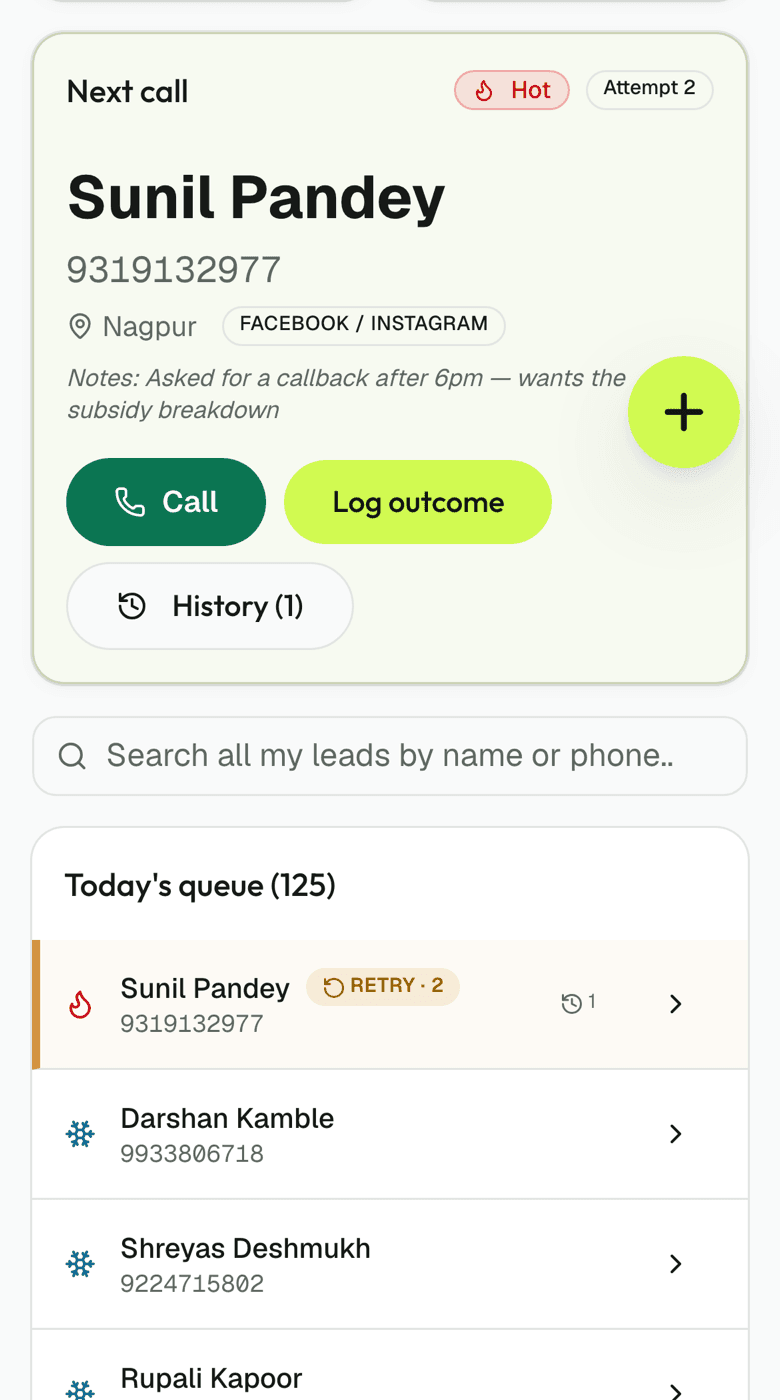
Site visits stop falling through when speed is built in, not layered on top. Qualification on the call, appointment on the calendar, notes with the salesperson—all before the person hangs up. Your competitor is already doing this. If you are not, every lead that goes quiet is one they took.
Related
Run one real project through it this month. You will know by the end of it.
30 days free, no card, no call. Then ₹10,000 a month for the whole company, however many people you put on it.