A solar EPC stalls when the paperwork cannot keep pace with a growing sales team.
What your first project actually costs
A rooftop solar project in the three-to-ten-kilowatt range, the size band most residential EPC work falls into, runs to roughly five to fifteen lakh rupees in material, labour and engineering as an illustrative range — the customer pays that. Your own costs as an EPC are not the install. They are the lead, the survey, the paperwork, the loan approval and the waiting. A salesperson can take a month on the phone to close one deal. A technician travels for three site surveys before one becomes a sale. Your office sends documents to four different places and gets rejected by one.
The lead itself costs you something, typically one thousand to ten thousand rupees, whether it comes from a telecaller, a digital-ad platform, or a referral network that takes its own share. The site visit costs roughly five hundred rupees in fuel plus a day of someone's time. The loan stage costs about two weeks of coordination with three different agencies, during which you are carrying the project's weight and no money has arrived. In the field, the install costs whatever labour the local market charges, and in the office it costs roughly one staff member for every thirty projects, sitting with DISCOM paperwork and documentation.
Take a twenty-project month at ten lakh rupees each as an illustrative example: you might collect around ninety lakh rupees in that month, while carrying forty lakh rupees in loans you funded early or final payments still stuck in instalments. Money commonly arrives in pieces (ten per cent advance, seventy per cent on delivery, twenty per cent at completion), and the bank, when a loan is involved, pays you last. This is normal in solar. Treating it as a surprise cost by the second month is how new EPCs run out of cash.
Licences, GST and the paper trail
You need a registered business entity, sole proprietorship, LLP or private limited company, and a PAN. A solar EPC does not need a specific solar licence to operate in India, and MNRE's rooftop solar subsidy scheme does not gate on licensure — but you will need a trade licence from your municipal corporation. Most municipalities issue one for under five thousand rupees if you own or lease your premises.
GST on a solar EPC contract is not a flat eighteen per cent. Under the CBIC's rule for composite solar-power-generating-system supplies (Notification 24/2018-Central Tax (Rate)), an invoice that bundles panels, inverter, structure, labour and engineering into one line is treated as seventy per cent goods and thirty per cent services, each taxed at its own rate. Itemise that same invoice instead, and every line reverts to its own rate. Which way you invoice changes what the customer pays and what you can claim back, so get your first few filings checked by an accountant who has handled a solar EPC's returns before an audit finds the mistake.
Documents are the second-largest cost sink after the install itself. You collect the customer's Aadhaar, PAN, electricity bill and bank statement. You photograph the roof and send it to a feasibility engineer. You wait for DISCOM approval on the net-meter application, then submit to the subsidy portal if the customer qualifies. That DISCOM wait varies a lot by state and by how complete the paperwork is — generally faster in Delhi (BRPL, BYPL, TPDDL) than in Uttar Pradesh (PVVNL, NPCL) or Haryana (DHBVN, UHBVN), and slower again if a document has to be resubmitted. Loans add another agency with its own paperwork on its own clock. A project that skips any of this discovers the gap on completion day.
Margins and when you stop being broke
On a residential system, margins typically run ten to twenty per cent of the installed value, depending on your material costs and your local competition. Take an illustrative example: a three-kilowatt system at a wholesale price of one lakh twenty thousand rupees and a retail customer price of one lakh fifty thousand rupees puts your gross margin at thirty thousand rupees, twenty per cent of the sale. Add labour at fifteen thousand rupees and engineering at five thousand rupees, and you are down to ten thousand rupees, about seven per cent, before your office pays for a salesperson, fuel, rent or the months it takes to collect the final payment.
This is why scale matters. At ten projects a month, the salesperson, the office and the project-management overhead sit on each project's back and eat the margin. At fifty projects a month, that same overhead sits across fifty projects instead of ten, so overhead cost per project falls sharply — illustratively, from around three per cent of sale value to well under one per cent. You do not need five times the staff at fifty projects, but you do need a system that stops you losing a customer in the documentation queue, or dispatching material before the money for it has landed.
Budget cash to last well beyond your first year — the margins above are illustrative, and month one, at low volume, can run close to zero. At one Delhi-NCR EPC we work with, running this exact business, collections trail total sales value by one to two months on average, because most projects are still moving through the pipeline rather than finished. The first year is about building a process that can carry volume, not extracting money from it.
Dealer, partner or EPC, and how the margin differs
A solar dealer buys systems wholesale and resells them at a retail margin but never touches the installation. You hold a distributor's stock, take orders on their behalf, and keep the difference between wholesale and retail, typically two to five per cent as a dealer commission. A channel partner or affiliate does the same without holding inventory — you take orders and earn a commission instead. An EPC (Engineering, Procurement and Contractor) designs, procures materials and manages the installation, so you carry the engineer's fee, the project risk and the installation revenue together.
As a dealer or affiliate, your path to a margin is fast — it lands on every deal with no cash trapped in a project cycle. Your ceiling is the market you alone can reach. As an EPC, your margin is smaller as a share of the sale, your cycle is longer, and your cash is locked for months, but your ceiling is far higher because you are not capped by how many orders one person can place. On a one-lakh-fifty-thousand-rupee sale, a two-per-cent dealer commission is three thousand rupees; a ten-per-cent EPC margin is fifteen thousand rupees. Run fifty deals a month and the gap compounds.
Most EPCs start as dealers to prove demand in their market, then move into self-installation once the model works. The risk runs backwards if you skip that step: start as an EPC, fail on operations, and you lose money on every project instead of earning a commission on none. Start as a dealer, learn the market, and become an EPC once your pipeline can carry it. The catch is that solar module and system prices keep falling year on year, which compresses a percentage-based dealer commission along with them — a fixed rate on a shrinking price is a shrinking cheque. EPC margin holds up differently, because it is a share of a job you control end to end, so volume drives it more than price does.
What it takes to grow a solar business past fifteen projects a month
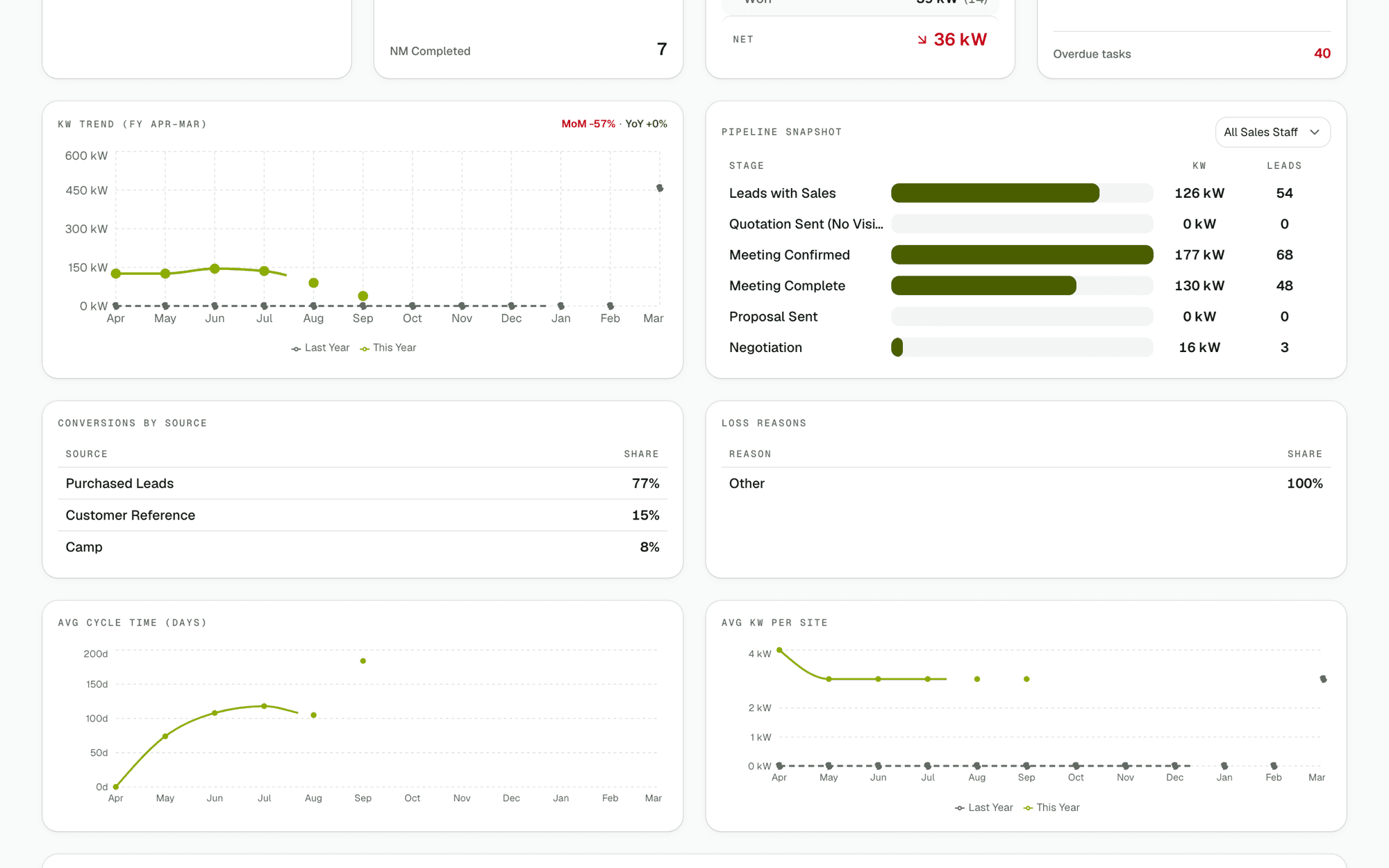
A small team (one salesperson, one site surveyor, one installer, one driver, one office admin) can realistically run five to fifteen projects a month as an illustrative range; the ceiling moves with customer density and how spread out the market is. One Delhi-NCR EPC we work with is not that five-person team: at its best month so far, it ran a meaningfully larger volume with a bigger sales and operations bench, a general manager, and an AI telecaller working the calling queue alongside human telecallers. The lesson is not that a five-person team can secretly run many times its own volume — it is that the team, the checklist and the payment rules all had to grow together.
The bottleneck is rarely the work itself. A three-kilowatt residential install takes one day once the team is on site. The bottleneck is the waiting: a salesperson can spend three weeks on two projects before either closes, because the customer's own decision cycle runs about four weeks. A surveyor might complete ten surveys a month but see half fail inspection. A loan agent processes six applications a month and four get approved. Money arrives in pieces across three or four months. A team hits a wall at fifteen projects not because it works too slowly, but because the work becomes invisible and nothing forces it back into view.
One lever this EPC found did not require adding a person: an AI telecaller that, per hundred dials, booked more site visits than its human telecallers (see the figures below), adding telecalling capacity without a fourth telecalling hire. The other lever was the payment gate — material never dispatched before the required share of money had arrived, sixty-five per cent on loan-backed deals and ninety-five per cent on cash ones. Headcount did grow over the same window, but not nearly as fast as the volume the pipeline carried.
Why the business breaks the day you hire a second salesperson
When you are the whole team (selling, surveying, installing, collecting money), you hold it all in your head. A customer gets a follow-up call when you remember to make it. A project moves to its next stage when you finish the one before it. This works until you hire a second salesperson and discover neither of you knows what the other promised the customer. Money gets collected by whoever takes the call from an angry customer. The business was never broken; the system was you.
A system that scales looks like this: every project enters a stage with its checklist already written, one item per task with its own due date, branching on whether the deal has a loan, a subsidy, or a particular DISCOM. Nobody types the checklist. Nobody decides when an item is due. If a project falls behind, the work escalates automatically at night to the next level of management, from the salesperson to the sales head, from the site coordinator to the operations head, until someone fixes it or the director already knows it is stuck.
Cash before material is not optional — it is where the maths closes. Collect twenty-five per cent before structure dispatch, then sixty-five per cent before material dispatch on a loan-backed job or ninety-five per cent on a cash one, all of it before net-meter activation, and all of it again before the project can be marked complete. If a customer has not paid what the stage requires, the material stays in the warehouse and the project stops. This feels harsh until you have run out of cash funding a customer's delay.
Four gates hold this together: the stage gate (a project cannot move forward while its checklist has open items), the payment gate (material does not move until the agreed share of money has arrived), the document gate (a photographed document is not marked done until someone in operations marks it correct), and the escalation gate (overdue work moves one rung up the org chart every night, automatically). None of these is a meeting. Each is a rule that runs itself, and it is what lets a team of five that was drowning at fifteen projects handle thirty or more, because the work stops being invisible.
Calling, qualifications and the speed of the lead
A lead has a shelf life. A customer who fills in a solar-interest form on Facebook is ready to talk that day — ring them that afternoon and you have a real shot at a site visit. Call on Wednesday morning and you are behind two other EPCs who called on Tuesday. Many EPCs still run their calling process the old way: the form goes into a spreadsheet, the spreadsheet reaches a telecaller on Monday morning, and by Friday some of that week's leads are dead or already called by someone else.
A system built for this closes that gap: the lead lands in the calling queue within five minutes of the form being submitted, a PIN check confirms the customer's address sits inside a serviceable area before anyone dials, and every outcome (qualified, visited, converted, wasted) gets logged back to the ad platform so it learns which leads convert. That queue is what a human telecaller and an AI telecaller both work from; neither one is waiting on a spreadsheet.
Calling can be hybrid: an AI telecaller (Ringg AI, in the case of one Delhi-NCR EPC we work with) dials fresh ad leads nine a.m. to nine p.m. IST, asks about load and roof space to qualify the customer, and books site visits straight into a named salesperson's calendar. It works there: the AI telecaller booked more site visits (322) than any of its three human telecallers (110 to 168 each) over roughly three and a half months, despite handling fewer dials than any single human (4,922 versus 10,040 to 10,682 per human).
What Solar Spine adds to this process
Common questions when starting a solar business
How much investment is needed to start a solar business in India?
Budget five to fifteen lakh rupees for your first residential rooftop project as an illustrative range covering material, labour and engineering — money the customer ultimately pays, but that you carry first. Add two to five lakh rupees in working capital for lead generation, payroll, rent and fuel before that money arrives. Expect thin or negative margins in your first few months while volume is low; profitability depends far more on reaching enough projects a month to spread fixed costs than on any fixed timeline. A dealer or channel-partner model needs less capital but caps how far your revenue can grow.
Is a licence required to start a solar installation business?
You need a registered business entity, sole proprietorship, LLP or private company, and a PAN. Most municipal corporations issue a trade licence for under five thousand rupees once you have business premises. MNRE's rooftop solar subsidy scheme does not require a specific solar licence to apply, but your state electricity board may have its own registration or net-metering agreement requirements before you can connect a system to the grid. Check your state DISCOM's current circular before you commit to a customer's timeline, since requirements and processing times differ by board.
What is the typical profit margin in the solar EPC business in India?
Gross margins on a residential system typically run ten to twenty per cent of the installed value, but net margins are thinner once you account for staff, fuel, rent and the months it takes to collect the final instalment. On a one-lakh-fifty-thousand-rupee sale at ten per cent gross margin, that is fifteen thousand rupees per project before overhead. Overhead per project falls sharply as volume rises, because the same salesperson, office and operations staff carry more projects each month — this is the main lever that turns a marginal business into a profitable one, more than any change in price.
Should I become a solar dealer, a channel partner, or run my own EPC?
Start as a dealer or channel partner if you want a margin on each sale without carrying project risk or tying up cash for months — commission typically runs two to five per cent, paid faster than an EPC margin. Move to full EPC (design, procurement and installation) once demand is proven, because a percentage-based dealer commission shrinks as solar prices fall, while EPC margin scales with the volume of projects you run yourself. The trade-off: EPC carries operational risk a dealer never sees, and a botched installation or a stalled net-meter file costs you money you have already spent.
What GST and trade-licence registration does a solar business need?
Register for GST before you invoice a customer. A solar EPC contract is not taxed at a flat rate: under CBIC's rule for composite solar power system supplies, an invoice that bundles panels, structure, labour and engineering into one line is treated as seventy per cent goods and thirty per cent services, each at its own GST rate, while itemised invoices tax each line separately at its own rate instead. How you invoice changes what the customer pays and what you can claim back, so get your first few filings checked by an accountant who has handled a solar EPC's returns before an audit finds the mistake.
How many solar projects can a small EPC team realistically handle per month?
A small team (one salesperson, one surveyor, one installer, one driver, one office admin) can realistically run five to fifteen projects a month as an illustrative range; the ceiling moves with customer density and how spread out the market is. The bottleneck is rarely labour — it is waiting on customers, banks and DISCOMs. Same-day or next-day contact on fresh leads, automated checklists with deadlines written the moment a stage opens, and a rule that material does not move until the agreed share of money has landed all raise that ceiling without adding headcount.
Is the solar business still profitable in India in 2026?
Yes, for operators who run it as a process rather than a side project. Solar module and system prices have kept falling year on year, which compresses margin for anyone reselling on a fixed percentage, but EPC margin on design, engineering and installation holds up better because it scales with volume rather than price. The businesses that struggle are the ones treating the first twenty projects as a side venture worked around another job. Hire a small team by month three, put deadlines and payment gates around the work, and the business supports itself past that point.
Where this leads next
Run one real project through it this month. You will know by the end of it.
30 days free, no card, no call. Then ₹10,000 a month for the whole company, however many people you put on it.