Every PM Surya Ghar deadline lives on a task before the money lands.
What the PM Surya Ghar subsidy process pays, and when
The PM Surya Ghar Muft Bijli Yojana pays a capital subsidy on residential rooftop solar systems in India, on capacity up to 10 kW. The subsidy is ₹30,000 per kW for the first 2 kW, then ₹18,000 for the third kW, capped at ₹78,000 for any system of 3 kW or larger — a 5 kW system draws the same ₹78,000 as a 3 kW one. The scheme launched on 13 February 2024 with ₹75,021 crore allocated to reach one crore households by March 2027, and carries no published end date, but individual state pools close once exhausted, so eligibility inside a state is first-come, first-served.
Subsidy is paid only after the system is commissioned and generating power, not at booking, not at installation, not when the net-meter application is filed. The applicant must own the roof or hold a written agreement to use it for the system's life, and eligibility is limited to residential buildings: single flats, independent houses and group housing on a domestic tariff. Commercial and industrial buildings do not qualify for this subsidy, even on the same roof.
To claim it, you file a PM Surya Ghar application on the national portal (pmsuryaghar.gov.in) before your state's allocation is exhausted, with the Aadhaar number of the roof owner, proof of ownership or a tenancy agreement, the sanctioned load from the electricity bill, and a feasibility report. The modules must appear on MNRE's Approved List of Models and Manufacturers (ALMM), the domestic-content list that gates every subsidy claim under the scheme. Once the application is accepted onto a state's list, the project moves through installation, DISCOM approval and commissioning on a timeline the state's nodal agency sets, not the applicant's.
Work out the central subsidy for a system
Central financial assistance under PM Surya Ghar, from MNRE's operational guidelines of 7 June 2024. Move the slider to the system size; state top-ups and DISCOM steps are separate.
Capex mode, one grid-connected system per residential connection, ALMM-and-DCR modules — the case the guideline actually prices.
Net metering and gross metering explained
Net metering and gross metering are two arrangements for how your solar system's power is measured and credited. Under net metering, your system connects to the grid, and the meter runs backwards while you export surplus power. At month end, the DISCOM credits you for net exports: the power you sent to the grid minus the power you drew from it. This is the default arrangement for most residential systems under PM Surya Ghar, and usually gives the better return, since you offset your own consumption before exporting the rest.
Gross metering requires a separate export meter. All power your system generates is metered and fed to the grid, and you are credited per unit exported, often at a different rate than your consumption tariff, while your own consumption still comes from the grid at the normal rate. It is less common for residential systems because it needs two meters and typically yields lower returns unless the export rate is attractive. Which arrangement applies depends on your DISCOM's policy; most allow net metering, though some older or congested networks still restrict it.
Your DISCOM sets its own approval timeline, and it is written into regulation, not custom. Delhi's DERC gives distribution licensees 15 days to complete technical feasibility on a complete application, under the (First Amendment) Regulations, 2024; in practice BRPL, BYPL and TPDDL applications run 25 to 50 days end to end once inspection and meter installation are added. Uttar Pradesh's UPERC rules allow 30 days for feasibility and a further 10 for approval, so PVVNL and NPCL applications typically take 6 to 10 weeks. Haryana's HERC rules require feasibility verification within 15 days, and DHBVN and UHBVN then take 4 to 8 weeks to install the meter. At one Delhi-NCR EPC we work with, the net-meter activation stage, which sits with the DISCOM and outside the EPC's own control, is consistently one of the slower stages in the pipeline. A CRM task with a 14-day due date, refreshed each time the DISCOM asks for something, catches a board that has gone quiet before the customer does.
Domestic-content panels and the ALMM list
The PM Surya Ghar scheme requires solar modules to be sourced from MNRE's Approved List of Models and Manufacturers (ALMM). The list names the module brands and specific model numbers that meet domestic-content thresholds, so subsidy under the scheme stays tied to panels made in India. You can download the current ALMM list from the MNRE website (mnre.gov.in) as a searchable file. When quoting or purchasing modules, check the model number against the latest list — a module that drops off it is rejected at subsidy approval, and replacing it means delay and an unhappy customer.
Non-DCR, non-ALMM modules cost less because they are imported, but they disqualify the project from PM Surya Ghar subsidy. For a purely cash, non-subsidy residential project, cheaper modules are a fair choice. But if a customer expects the subsidy, ALMM-listed modules are the only path, so document the choice and record the exact models before you invoice. A task due on the day a project enters the document-verification stage, checking the module specification against the current list, catches a mismatch before it becomes a three-week delay.
Why loan sanction is the slowest stage in the file
If the customer needs a loan, sanction is the single biggest delay in a rooftop solar project. Once your team submits a complete application, the wait belongs to the bank, not to you, and any missing document restarts the clock. At one Delhi-NCR EPC we work with, loan sanction is the slowest stage in the file, and a meaningful share of applications run well past the bank's own stated timeline. A CRM task dated four calendar days after the loan application is filed will be consistently overdue on the median file, and that is deliberate: it flags the team to chase the bank rather than wait for the customer to call.
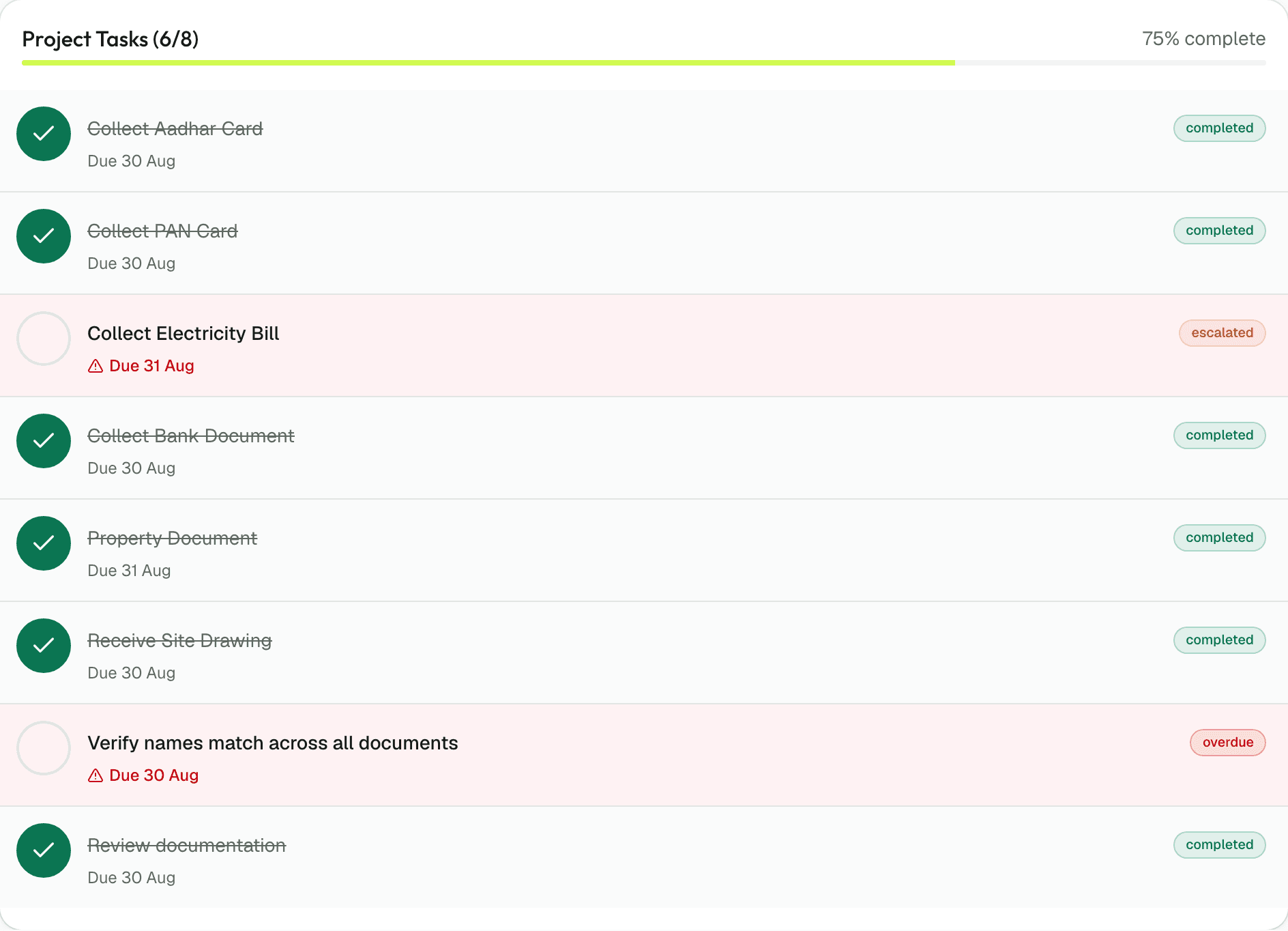
How Solar Spine tracks the PM Surya Ghar subsidy process
Questions people ask about the PM Surya Ghar subsidy process
How much subsidy do I get for a 3 kW rooftop solar system under PM Surya Ghar?
A 3 kW system draws the maximum subsidy of ₹78,000, made up of ₹30,000 per kW for the first 2 kW and ₹18,000 for the third. A larger system, up to the scheme's 10 kW ceiling, draws the same ₹78,000; the subsidy does not keep scaling past 3 kW. It is paid only after the system is commissioned, grid-connected and generating power, with the DISCOM's net-meter activation on record. You cannot claim it before commissioning.
Who is eligible for the PM Surya Ghar Yojana subsidy?
Residential roof owners in India who own the roof or hold a written lease agreement covering the system's life. The building must be used as a residence: a single flat, an independent house, or group housing on a domestic tariff. Commercial and industrial buildings do not qualify. Your state must still have funds available; once a state's allocation is exhausted, the scheme closes to new applicants there until it is replenished.
Is the solar subsidy paid before or after installation?
The subsidy is paid after the system is commissioned and actively generating power. You cannot draw it as an advance, and a customer cannot use it to reduce the down payment. Once the system is working and the DISCOM has activated the net meter, the DISCOM sends commissioning confirmation to the PM Surya Ghar portal, and the subsidy is transferred to the applicant's bank account by direct benefit transfer.
What is the difference between net metering and gross metering?
Net metering lets a single bidirectional meter run backwards when you export power, crediting you for net exports (power sent minus power drawn). Gross metering needs two separate meters, one for generation and one for consumption, and you are credited only for power exported, at a separate rate. Net metering gives better returns for most residential systems and is the default under PM Surya Ghar.
Do I need DCR panels to claim the PM Surya Ghar subsidy?
Yes. Every module must appear on MNRE's Approved List of Models and Manufacturers (ALMM), which certifies domestic-content compliance. A module that is not on the list disqualifies the project from PM Surya Ghar subsidy, even if it was on the list when you first quoted the job. Download the current ALMM list from mnre.gov.in and check your exact model number before you quote the customer.
What documents are required to apply for the rooftop solar subsidy?
The applicant needs an Aadhaar number linked to the bank account that will receive the subsidy, proof of roof ownership or a signed tenancy agreement covering the system's life, the sanctioned load from the electricity bill, and a feasibility report. Once the system is built, you submit the commissioning certificate and the DISCOM's net-meter activation letter to complete the claim.
How long does DISCOM approval take for net metering?
Delhi's DERC requires a feasibility decision within 15 days of a complete application, but BRPL, BYPL and TPDDL applications typically run 25 to 50 days end to end once inspection and meter installation are counted. Uttar Pradesh's PVVNL and NPCL, and Haryana's DHBVN and UHBVN, both tend to run 4 to 10 weeks depending on the division handling the file. These are the regulatory deadlines and typical practice, not a guarantee, so a follow-up call is worth making once a step passes its stated deadline.
PM Surya Ghar project checklist
- Verify Aadhaar, PAN and electricity bill from customer
- Confirm ALMM-listed modules are specified in the quote
- File PM Surya Ghar application on national portal before state allocation closes
- Obtain DISCOM approval for net metering (allow 4 to 10 weeks depending on state and division)
- Complete site survey and feasibility report (allow a couple of days after the site visit)
- Loan application to bank if customer needs financing (sanction typically the slowest single step)
- Procure and install structure and modules (allow around 10 days after material arrives)
- Interconnection approval from DISCOM (allow several weeks after installation, depending on DISCOM)
- Meter installation and net-metering activation by DISCOM
- Commissioning certificate and performance test
- Submit proof of commissioning to PM Surya Ghar portal for subsidy release
Where this leads next
Run one real project through it this month. You will know by the end of it.
30 days free, no card, no call. Then ₹10,000 a month for the whole company, however many people you put on it.